Major, Minor, and Exotic Currency Pairs Explained: Which Should You Trade in 2026?
Financial Disclaimer: This content is for educational purposes only and does not constitute financial advice. Currency trading involves substantial risk of loss. Please seek independent financial guidance before making any trading decisions.
One of the first decisions every forex trader must make is which currency pairs to trade. In 2026, the global forex market offers hundreds of tradeable currency combinations, but the practical universe for most traders narrows considerably once you understand the structural differences between major, minor, and exotic currency pairs. Each category carries a distinct risk profile, liquidity characteristic, and cost structure that directly affects your profitability and trading experience.
This guide breaks down all three categories with 2026 spread data, volume statistics, and clear guidance on which type of pair is appropriate for which type of trader.
What Are Major Currency Pairs and Why Do They Dominate Forex Volume?
- Major, Minor, and Exotic Currency Pairs Explained: Which Should You Trade in 2026?
- What Are Major Currency Pairs and Why Do They Dominate Forex Volume?
- Minor Currency Pairs: Definition, Examples, and Spread Differences
- Exotic Currency Pairs: High Risk, High Reward Opportunities
- Comparing Spreads and Liquidity Across Pair Types
- Best Currency Pairs for Beginners Versus Experienced Traders in 2026
- Key Takeaways on Currency Pair Selection
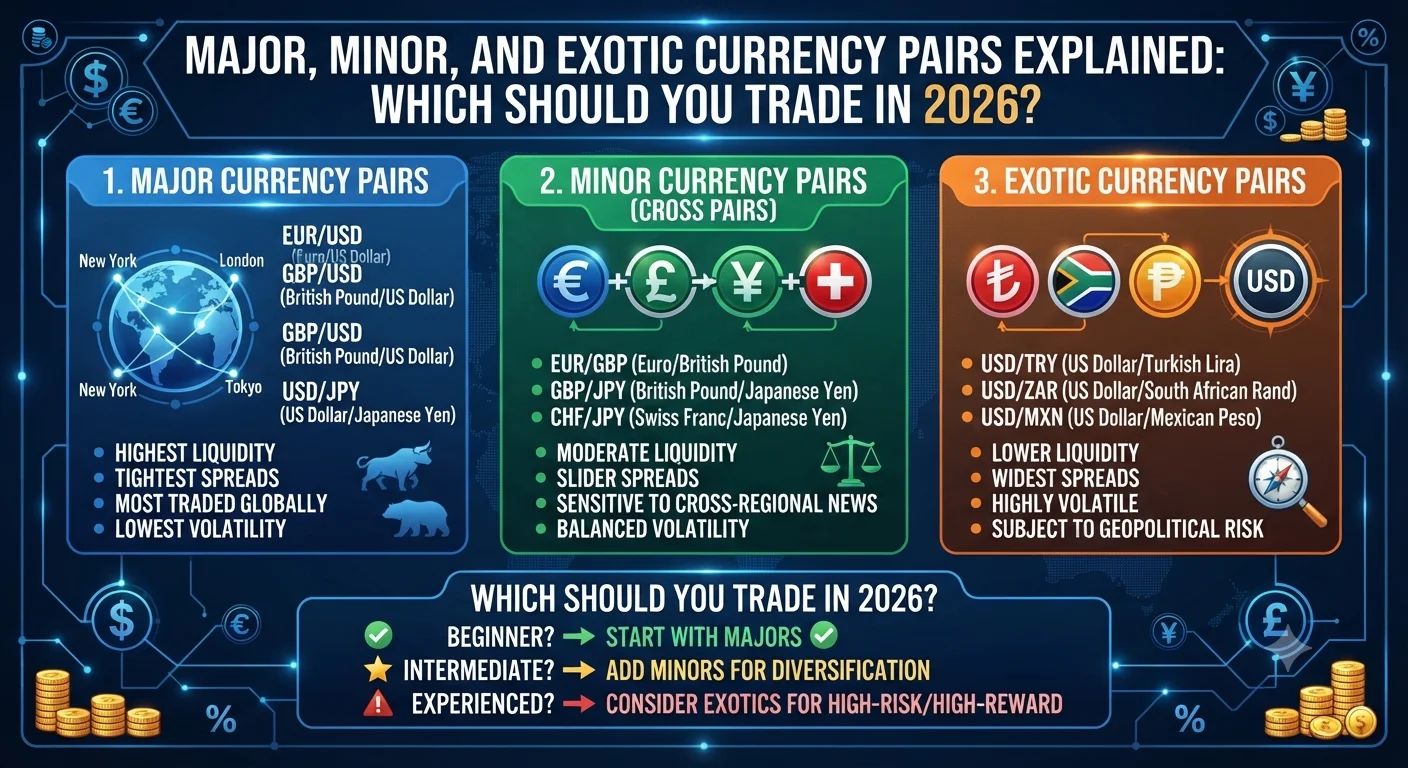
Major currency pairs are the seven currency pairs that all include the US dollar as either the base or quote currency. They are the most heavily traded instruments in the global forex market and collectively account for approximately 75% of all daily trading volume as of 2026.
The seven major pairs are EUR/USD (euro versus US dollar), GBP/USD (British pound versus US dollar), USD/JPY (US dollar versus Japanese yen), USD/CHF (US dollar versus Swiss franc), AUD/USD (Australian dollar versus US dollar), USD/CAD (US dollar versus Canadian dollar), and NZD/USD (New Zealand dollar versus US dollar).
The dominance of the US dollar in this group reflects the dollar's role as the world's primary reserve currency. According to the International Monetary Fund (IMF), the US dollar accounted for approximately 58% of global foreign exchange reserves in 2025, down from its peak of 71% in 2001 but still commanding an overwhelming share. The dollar's role in international trade invoicing, commodity pricing (oil and gold are priced in USD globally), and sovereign debt issuance ensures persistent demand in every corner of the forex market.
EUR/USD alone accounts for roughly 22 to 24% of total global forex volume on any given trading day. It is the benchmark pair for the entire market, and its price behavior influences nearly every other currency pair through correlation dynamics.
Why majors suit most traders: Major pairs offer the tightest spreads in the market. At a regulated ECN broker in 2026, EUR/USD typically trades with a raw spread of 0.1 to 0.3 pips, GBP/USD at 0.3 to 0.6 pips, and USD/JPY at 0.1 to 0.4 pips during peak London-New York session hours. These tight spreads reduce the cost of trading significantly and allow tighter stop placement relative to the spread.
Major pairs also benefit from the most abundant supply of fundamental analysis, economic data, and market commentary. The Federal Reserve, ECB, BOE, and BOJ all publish detailed meeting minutes, forward guidance, and economic projections, giving traders substantial information to build fundamental biases. This transparency and information density makes major pairs the appropriate starting point for any trader at any experience level.
Minor Currency Pairs: Definition, Examples, and Spread Differences
Minor currency pairs, sometimes called cross pairs, are currency pairs that do not include the US dollar but combine two other major currencies. Common examples include EUR/GBP (euro versus British pound), EUR/JPY (euro versus Japanese yen), GBP/JPY (British pound versus Japanese yen), EUR/AUD (euro versus Australian dollar), and AUD/JPY (Australian dollar versus Japanese yen).
Because minor pairs exclude the dollar, their liquidity is lower than the majors, though still substantially higher than exotic pairs. This reduced liquidity is reflected in wider spreads. In 2026, EUR/GBP typically trades at spreads of 0.5 to 1.0 pips at ECN brokers, GBP/JPY at 0.8 to 1.5 pips, and EUR/AUD at 0.8 to 1.2 pips during standard trading hours. Spreads can widen meaningfully during off-peak hours, particularly during the Sydney and early Tokyo sessions.
Minor pairs offer traders an important advantage: they provide exposure to economic stories that major pairs may not capture cleanly. EUR/GBP, for example, captures the pure relationship between eurozone and UK economic conditions without the distorting influence of US dollar movements. This makes cross pairs particularly useful for traders who form views on specific regional economic divergences.
GBP/JPY deserves special mention as perhaps the most popular minor pair in 2026. It is known for its wide daily ranges, often moving 100 to 200 pips or more on high-activity days, making it attractive to experienced scalpers and day traders who have the risk management skills to navigate its volatility. Beginners should approach GBP/JPY with caution and smaller position sizes until comfortable with its behavior.
Recommended Articles
 FOREX TRADING
 FOREX TRADING
 FOREX TRADING
The yen crosses, specifically AUD/JPY and NZD/JPY, function as risk sentiment barometers in 2026. These pairs tend to rise when global risk appetite is strong (investors borrow cheap yen to buy higher-yielding Australian and New Zealand dollars) and fall sharply during risk-off events when yen safe-haven demand surges. Monitoring these pairs provides an additional layer of insight into the broader market mood.
Exotic Currency Pairs: High Risk, High Reward Opportunities
Exotic currency pairs combine one major currency (usually the USD, EUR, or GBP) with the currency of an emerging or smaller economy. Examples include USD/TRY (US dollar versus Turkish lira), USD/ZAR (US dollar versus South African rand), USD/MXN (US dollar versus Mexican peso), EUR/PLN (euro versus Polish zloty), and USD/SGD (US dollar versus Singapore dollar).
Exotic pairs are defined by three core characteristics: significantly lower liquidity than majors and minors, substantially wider spreads, and higher susceptibility to political and economic instability in the smaller economy. In 2026, spreads on USD/TRY routinely reach 20 to 60 pips, and USD/ZAR spreads typically range from 30 to 80 pips depending on market conditions. These spreads represent a much larger cost relative to the pair's average daily pip movement.
Exotic pairs often experience extreme volatility around political events, central bank decisions, and economic crises specific to the smaller economy. Turkey's persistent inflation challenges and the Turkish central bank's unconventional policy responses, for example, have created massive USD/TRY moves throughout 2023, 2024, and 2025. South Africa's rand remains sensitive to gold and platinum prices, domestic political developments, and Eskom power supply issues.
This category of pairs is not recommended for beginners or even many intermediate traders. The wide spreads mean a trader must endure a much larger adverse move before reaching breakeven on any position, and the heightened volatility can trigger stop losses before the anticipated move materializes. Experienced traders who specialize in macroeconomic and geopolitical analysis may find compelling opportunities in exotic pairs, but they must account for the cost structure and liquidity risk in every position.
Comparing Spreads and Liquidity Across Pair Types
To illustrate the practical cost difference between pair types, consider a trader placing a one micro lot position (1,000 units) on three different pairs in 2026 using a regulated ECN broker:
On EUR/USD with a 0.2-pip spread, the round-trip cost is approximately $0.20. On GBP/JPY with a 1.0-pip spread, the cost is approximately $0.65 at current exchange rates. On USD/TRY with a 40-pip spread, the cost is approximately $1.40 at current rates.
Scaled to a standard lot, these costs become $20, $65, and $140 respectively. Over 100 trades per month, the difference in transaction costs between EUR/USD and USD/TRY amounts to $12,000 annually at standard lot size. This cost differential is a fundamental reason why most professional traders focus primarily on major pairs unless they have a specific, well-researched reason to trade exotics.
Best Currency Pairs for Beginners Versus Experienced Traders in 2026
For traders in their first six months of forex trading, EUR/USD is the universal recommendation. It offers the tightest spreads, the most abundant educational resources, the highest liquidity (meaning slippage is rare), and predictable behavior around well-scheduled economic events such as US CPI releases, NFP reports, and Fed meetings. GBP/USD and USD/JPY are appropriate secondary pairs once familiarity with EUR/USD is established.
For traders with six to twenty-four months of experience, adding one or two minor pairs such as EUR/GBP or AUD/JPY can provide useful diversification and exposure to different economic cycles. GBP/JPY becomes appropriate once a trader has demonstrated consistent risk management discipline, given its higher volatility.
For experienced traders with a strong fundamental analysis background, selective use of exotic pairs such as USD/MXN or USD/ZAR can offer high volatility opportunities. However, position sizing must be reduced significantly relative to major pair trades to account for wider spreads and heightened overnight risk.
The most common mistake in 2026 is the same mistake traders made in 2010: spreading attention across too many pairs before building deep competence in any single one. Profitable traders almost universally develop a genuine expertise in one or two pairs before expanding their universe.
Key Takeaways on Currency Pair Selection
The type of currency pair you trade directly impacts your trading costs, risk exposure, and the quality of information available to support your analysis. Major pairs offer the lowest costs and highest liquidity, making them ideal for traders at every stage. Minor pairs add diversity and capture non-dollar economic stories with moderate additional cost. Exotic pairs carry high costs, wide spreads, and political risk that makes them appropriate only for experienced, well-resourced traders with specific analytical edges.
Start with EUR/USD, master it completely, then expand deliberately and purposefully as your skills and capital grow.