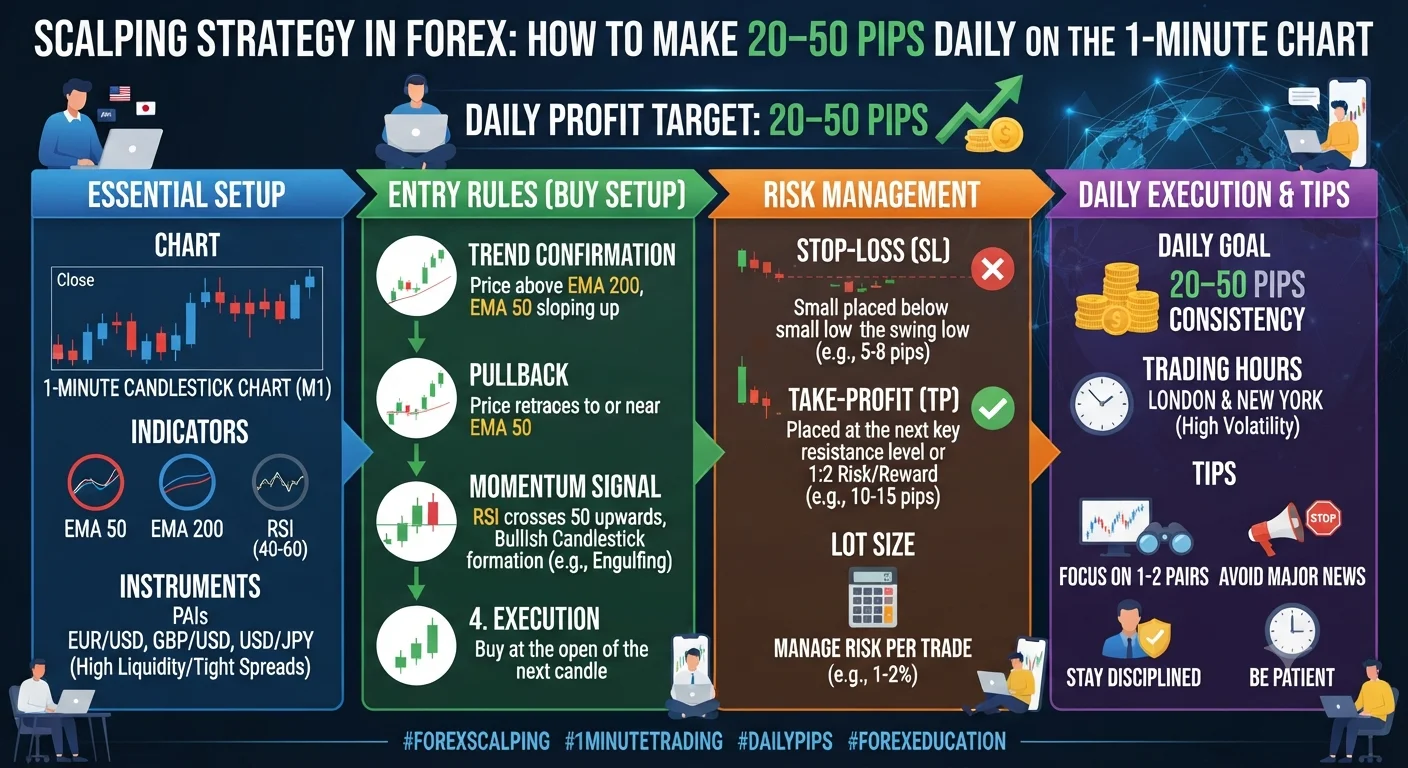
Forex scalping is a short-term trading strategy where traders open and close multiple positions within minutes, targeting small price movements of 2 to 10 pips per trade. On the 1-minute chart, scalpers accumulate 20 to 50 pips daily by repeating high-probability setups during peak liquidity sessions. In 2026, scalping is most effective on major pairs like EUR/USD and USD/JPY during the London and New York sessions when spreads are tightest and price movement is most predictable.
What Is Forex Scalping and Is It Right for You?
Forex scalping is one of the most active and demanding trading styles available to retail traders. A scalper enters and exits positions rapidly, often holding trades for 30 seconds to 5 minutes, targeting small but consistent price movements. Unlike swing traders who hold positions for days or position traders who hold for weeks, scalpers complete their entire trading activity within a single session and end each day with zero open positions.
The appeal of scalping is its frequency of opportunity. While a swing trader might identify two or three setups per week, a scalper can find 10 to 30 potential entries on any given trading day. Each individual trade targets a modest gain, but the compounding effect of consistent small wins, kept clean through disciplined risk management, builds meaningful returns over time.
However, scalping is not suitable for every trader. It demands intense concentration, fast decision-making, the ability to remain emotionally neutral through rapid wins and losses, and a reliable trading environment with a low-latency internet connection and a broker offering tight spreads with fast order execution. In 2026, brokers offering execution speeds under 50 milliseconds and raw spreads on EUR/USD below 0.3 pips have made scalping significantly more viable for retail traders than it was even five years ago.
Before committing to scalping as your primary style, honestly assess whether you can maintain sustained focus for two to four hours, whether you respond calmly to rapid market moves, and whether your broker infrastructure supports the strategy. If any of these conditions are not met, day trading or swing trading will likely produce better results with less psychological strain.
Best Currency Pairs and Sessions for Scalping in 2026
- What Is Forex Scalping and Is It Right for You?
- Best Currency Pairs and Sessions for Scalping in 2026
- Setting Up the 1-Minute and 5-Minute Scalping Chart
- Entry, Exit, and Stop Loss Rules for Consistent Scalping Profits
- Top 5 Mistakes Scalpers Make and How to Avoid Them
- Key Takeaways for Forex Scalpers in 2026
Not all currency pairs are equally suited to scalping. The most important criteria for a scalping pair are tight spreads, high liquidity, and consistent intraday volatility. In 2026, the best currency pairs for scalping remain concentrated among the major pairs.
EUR/USD is the premier scalping pair globally. With average raw spreads of 0.1 to 0.3 pips at ECN brokers during peak hours, deep liquidity that prevents significant slippage, and a well-defined daily range of 50 to 90 pips in 2026 market conditions, EUR/USD provides the ideal environment for scalping strategies. The pair responds predictably to technical levels and generates clean, readable price action on short timeframes.
USD/JPY is the second most popular scalping pair. Its tight spreads (0.1 to 0.4 pips at leading ECN brokers), high liquidity, and tendency to trend smoothly during Asian and London sessions make it a strong alternative or complement to EUR/USD scalping. The pair is particularly active during the Tokyo session when yen-related news flow is highest.
GBP/USD offers wider daily ranges than EUR/USD, often moving 80 to 140 pips in a single day in 2026, creating more pip opportunity per scalp setup. However, its spreads are moderately wider (0.3 to 0.7 pips) and its price action is more volatile and less predictable on the 1-minute chart. It suits scalpers who have mastered EUR/USD and are seeking wider targets.
Session timing is equally critical. The optimal scalping window in 2026 is the London session (07:00 to 12:00 GMT) and the London and New York overlap (13:00 to 17:00 GMT). During these windows, institutional order flow is highest, spreads are at their tightest, and the 1-minute chart generates clear, directional price action rather than the erratic, low-volume noise typical of the Asian late session or the pre-London early morning period.
Avoid scalping EUR/USD between 22:00 and 06:00 GMT. Spreads widen significantly during this window, often doubling or tripling, which eliminates the mathematical edge of small-target scalping trades.
Setting Up the 1-Minute and 5-Minute Scalping Chart
A clean, uncluttered chart is essential for scalping. Overloading the chart with indicators introduces decision lag, which is catastrophic in a strategy where entries and exits must be executed within seconds of a signal appearing.
The recommended scalping chart setup for 2026 uses the following configuration on MetaTrader 4, MetaTrader 5, or TradingView:
Primary chart: 1-minute timeframe for entry execution Context chart: 5-minute timeframe for trend direction and key levels Higher timeframe filter: 15-minute chart for session bias
Indicators on the 1-minute chart: The 8-period Exponential Moving Average (EMA) and the 21-period EMA provide immediate trend direction. When the 8 EMA is above the 21 EMA and price is trading above both, the bias is bullish and only long scalp entries are taken. When the 8 EMA is below the 21 EMA and price is below both, only short entries are valid.
Recommended Articles
 TRADING STRATEGIES
 TRADING STRATEGIES
 TRADING STRATEGIES
 TRADING STRATEGIES
The RSI set to a 7-period length on the 1-minute chart serves as the entry trigger. Long entries are taken when RSI dips below 30 and turns upward while price is above the EMAs. Short entries are taken when RSI rises above 70 and turns downward while price is below the EMAs.
Indicators on the 5-minute chart: A 50-period EMA on the 5-minute chart defines the medium-term trend. Scalp trades are only taken in the direction of this EMA. If the 5-minute 50 EMA is sloping upward, only long scalp signals from the 1-minute chart are acted upon, filtering out counter-trend entries that are lower probability.
This three-chart system creates a clear hierarchy: the 15-minute chart sets the session bias, the 5-minute chart confirms the intraday trend, and the 1-minute chart generates the specific entry signals.
Entry, Exit, and Stop Loss Rules for Consistent Scalping Profits
Clarity in entry and exit rules is what separates a scalping system from guessing. Every rule below should be treated as non-negotiable once the system is being traded live.
Entry rules for a long scalp: The 5-minute 50 EMA must be sloping upward. On the 1-minute chart, the 8 EMA must be above the 21 EMA. The RSI must dip below 30 and then cross back above 30 with the next 1-minute candle. Entry is placed as a market order at the open of the candle following the RSI cross. No entry is taken if the spread at that moment exceeds 1.5 pips on EUR/USD.
Entry rules for a short scalp: The 5-minute 50 EMA must be sloping downward. On the 1-minute chart, the 8 EMA must be below the 21 EMA. The RSI must rise above 70 and then cross back below 70. Entry is placed at the open of the next candle.
Stop loss placement: The stop is placed 5 to 8 pips below the entry for long trades and 5 to 8 pips above for short trades, positioned behind the most recent minor swing low or high visible on the 1-minute chart. Never use a fixed-pip stop without structural justification.
Take profit targets: Primary target: 10 to 15 pips from entry, representing a minimum 1:1.5 risk-reward ratio on a 7-pip stop. Extended target: 20 to 30 pips if the 5-minute trend is strongly directional with clear momentum. Trailing option: Move the stop to breakeven once 8 pips of profit is secured, then trail by 5 pips to lock in gains on extended moves.
Daily profit target and stopping rule: Set a daily pip target of 20 to 30 pips for beginning scalpers. Once achieved, stop trading for the day. Also set a daily maximum loss of 20 pips. If this is hit before the profit target, stop trading immediately. These rules prevent the most destructive scalping behavior: overtrading after a winning streak and revenge trading after losses.
Top 5 Mistakes Scalpers Make and How to Avoid Them
Mistake 1: Trading during low-liquidity periods. Scalping during the Tokyo session close or the pre-London hours generates false signals, wide spreads, and erratic 1-minute candles that do not respect technical levels. Restrict scalping to the windows identified above.
Mistake 2: Moving the stop loss wider after entry. This is the most dangerous habit in scalping. A scalp setup with a 7-pip stop should close at a 7-pip loss if wrong. Widening the stop to avoid the loss turns a controlled scalp into an uncontrolled directional bet and violates the risk management framework that makes the strategy viable.
Mistake 3: Ignoring the spread. On a 10-pip target trade, a 2-pip spread represents a 20% headwind from the moment the trade opens. Always check the current spread before entering any scalp and never trade when spreads have widened during news releases or off-peak hours.
Mistake 4: Increasing position size after wins. A winning streak feels like edge, but it is often partly luck. Doubling position size after three consecutive winners is how scalpers turn a profitable day into a loss. Lot size should remain constant based on the 1% risk rule at all times.
Mistake 5: Scalping on a slow or shared internet connection. In 2026, execution speed is a meaningful competitive factor in scalping. A 500-millisecond delay between signal and execution on a 10-pip target trade is catastrophic. Ensure a stable, dedicated broadband connection before scalping live.
Key Takeaways for Forex Scalpers in 2026
Scalping is a high-frequency, low-target trading style that generates consistent results through repetition and discipline rather than large individual wins. The 1-minute and 5-minute chart system using EMA alignment and RSI entry triggers provides a clear, rule-based framework. EUR/USD during the London session and London-New York overlap offers the ideal environment. Daily profit and loss limits enforce the discipline that prevents a good strategy from becoming a harmful habit. Practice this system on a demo account for a minimum of 30 trading days and track every metric before applying it to a live account.
Financial Disclaimer: This content is for educational purposes only and does not constitute financial advice. Forex trading involves a significant risk of loss. Always trade responsibly and within your means.