Quick Answer
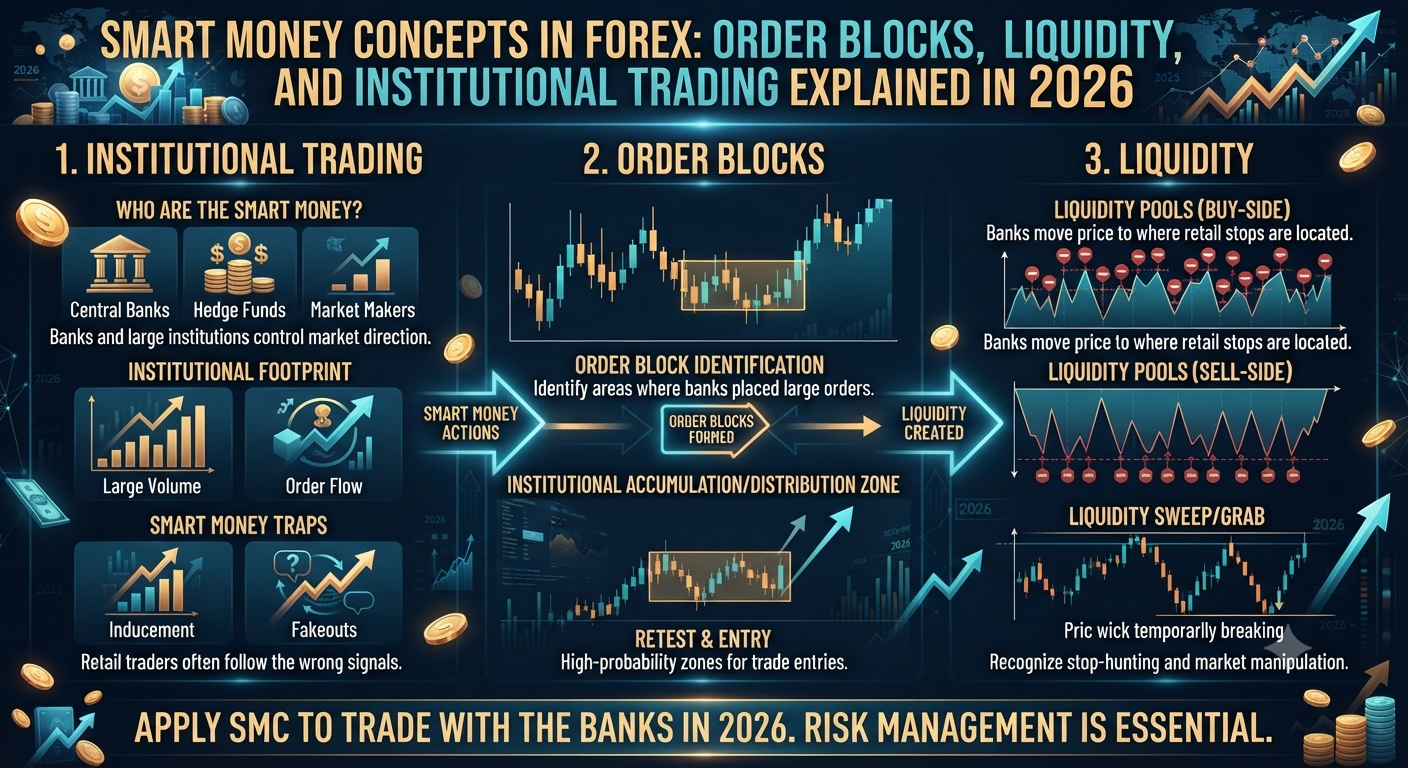
Smart Money Concepts (SMC) is a trading methodology that attempts to decode the behavior of institutional participants, including banks, hedge funds, and central banks, by analyzing price action through the lens of order flow, liquidity, and market structure. Key SMC concepts include order blocks (zones where institutions placed large directional orders), liquidity pools (clusters of stop losses that institutions target before moving price), break of structure (the confirmation that trend direction has changed), and change of character (the first signal that a trend may be reversing). In 2026, SMC has become one of the most discussed trading methodologies among retail traders, particularly through online communities and social media platforms.
What Is Smart Money Concepts and Who Trades This Way?
- Quick Answer
- What Is Smart Money Concepts and Who Trades This Way?
- Order Blocks: How to Identify Institutional Buying and Selling Zones
- Liquidity Pools, Stop Hunts, and How Banks Influence Retail Traders
- Break of Structure and Change of Character Explained
- Building an SMC Trading Model: From Market Structure to Entry
- Key Takeaways on Smart Money Concepts in 2026
Smart Money Concepts emerged as a distinct retail trading methodology in the late 2010s and gained enormous momentum through 2020 to 2024 as social media trading communities, particularly on YouTube and TikTok, popularized its vocabulary and analytical framework. The methodology is most closely associated with Michael Huddleston, known online as the Inner Circle Trader (ICT), whose educational content forms the theoretical basis of most SMC teaching in 2026.
The core premise of SMC is that retail traders consistently lose money because they are trading against, rather than alongside, the large institutional participants who actually move the forex market. According to SMC theory, banks and other smart money participants deliberately engineer price moves that trigger retail traders' stop losses and take their liquidity before reversing price in the true intended direction. By learning to identify where retail stop losses are clustered and where institutional orders have been placed, a trader can theoretically position alongside smart money rather than becoming its victim.
It is important to approach this framework with intellectual honesty. The claim that banks deliberately manipulate forex markets to hunt retail stop losses is not supported by the published academic literature on market microstructure. Large institutional participants do create significant price impact through their trading activity, but this is a consequence of their size rather than a deliberate strategy to victimize retail traders specifically. What SMC correctly identifies, even if the causal story is oversimplified, is that liquidity concentrations around obvious technical levels such as previous highs and lows, round numbers, and chart pattern boundaries do create predictable price behavior that can be traded with a defined edge.
In 2026, SMC is used by a significant portion of the retail trading community globally. Whether traders adopt the full philosophical framework or simply incorporate useful concepts such as order blocks and liquidity analysis into a broader technical approach, the vocabulary and analytical tools of SMC have become a meaningful part of the retail forex landscape.
Order Blocks: How to Identify Institutional Buying and Selling Zones
An order block in SMC terminology is a specific candle or small cluster of candles on a higher timeframe chart that preceded a significant, impulsive directional move. The theory behind order blocks is that large institutional participants placed their directional orders within that consolidation period, and when price returns to that zone later, the remaining unfilled institutional orders at that level create a high-probability reaction.
A bullish order block is identified by finding the last bearish (red) candle immediately before a strong bullish impulse move that broke a previous structure high. The body of that bearish candle becomes the bullish order block zone. The theory is that institutions were accumulating long positions during that bearish candle before pushing price aggressively higher. When price retraces to that zone in the future, the remaining institutional buy orders in that area create support and a likely bounce.
A bearish order block is the mirror: the last bullish (green) candle immediately before a strong bearish impulse that broke a previous structure low. The body of that bullish candle becomes the bearish order block zone. When price rallies back to that zone, institutional sell orders remaining in that area create resistance.
The practical criteria for a valid order block in 2026 SMC practice include the following requirements. The impulse move following the order block candle must be strong and impulsive, moving at least two to three times the range of the order block candle itself. The impulse must cause a break of a significant structural high or low rather than merely extending a move within an existing range. The order block zone should not have been revisited and fully traded through since its formation. Each time price returns to an order block and finds a reaction, some of the orders within it are consumed. An order block that has been tested multiple times carries diminishing analytical weight.
On the 4-hour EUR/USD chart, valid order blocks appear approximately two to four times per month, providing a manageable number of genuinely significant setups rather than the dozens of lower-quality setups that less-defined trading systems might generate. On the daily chart, valid order blocks are rarer but carry higher structural significance because they reflect daily timeframe institutional order flow.
Liquidity Pools, Stop Hunts, and How Banks Influence Retail Traders
Liquidity is the foundation of all SMC analysis. In market microstructure terms, liquidity refers to the availability of orders at a given price level. Large institutional participants seeking to fill enormous positions need liquidity on the other side of their trade. If a bank wants to sell one billion dollars worth of EUR/USD, it needs buyers of equivalent size on the other side. Retail traders' stop loss orders and pending orders provide this liquidity.
In SMC theory, liquidity pools are concentrations of retail trader stop losses that accumulate at predictable price locations. The most common liquidity pool locations are above swing highs (where retail traders who are short have placed their stop losses above the high) and below swing lows (where retail traders who are long have placed their stop losses below the low). Double tops and double bottoms are particularly rich liquidity pools because the obvious nature of these patterns causes large numbers of retail traders to place stops in the same location above or below the pattern's neckline.
A stop hunt, also called a liquidity sweep or a liquidity grab in SMC vocabulary, occurs when price briefly moves beyond an obvious liquidity pool location (sweeping above a swing high or below a swing low) before reversing sharply in the opposite direction. SMC traders interpret this sweep as institutional participants using the retail stop orders for liquidity to fill their opposing institutional positions.
Recommended Articles
 TRADING STRATEGIES
 TRADING STRATEGIES
 TRADING STRATEGIES
 TRADING STRATEGIES
From a practical trading perspective, regardless of whether the stop hunt narrative is literally accurate, the behavioral pattern it describes is real and observable on charts. Price frequently makes brief moves beyond obvious swing highs or lows before reversing. Waiting for this sweep to occur before entering in the reversal direction is a consistently applicable pattern that improves entry timing and reduces the frequency of being swept out of positions by the initial move.
The practical SMC entry approach at a liquidity level is as follows. Identify a significant swing high or swing low that has been respected multiple times, creating an obvious liquidity pool. Wait for price to briefly sweep beyond this level, taking out the obvious stops. Look for a sharp reversal candle (a bearish pin bar after sweeping above a high, a bullish pin bar after sweeping below a low) confirming the rejection. Enter in the direction of the reversal with a stop beyond the sweep high or low. Target the next significant structure level in the direction of the trade.
Break of Structure and Change of Character Explained
Break of Structure (BOS) and Change of Character (ChoCH) are the two market structure concepts that SMC uses to define trend direction and identify potential trend reversals.
Break of Structure (BOS) is the confirmation that the existing trend is continuing. In an uptrend, a BOS occurs when price creates a new higher high, breaking above the most recent swing high. This confirms that the bullish market structure remains intact. In a downtrend, a BOS occurs when price creates a new lower low, breaking below the most recent swing low. A BOS in the direction of the prevailing trend is a continuation signal. SMC traders use BOS confirmations to validate that they are entering in the direction of the dominant structure and to identify the most recent liquidity level taken before the continuation.
Change of Character (ChoCH) is the first signal that the existing trend may be reversing. In an uptrend, a ChoCH occurs when price breaks below a significant higher low (a structural low that was formed during the uptrend). This is the first time that the bearish price movement has broken a meaningful structural level, suggesting that the bullish structure may be failing. In a downtrend, a ChoCH occurs when price breaks above a significant lower high.
The distinction between BOS and ChoCH is important because it separates high-confidence trend continuation signals from potential reversal signals that require additional confirmation. A BOS in the direction of the existing trend is a straightforward continuation entry context. A ChoCH signals a structural shift but does not, by itself, confirm a full trend reversal. SMC traders typically require a ChoCH followed by the formation of a new lower high (in a potential downtrend reversal) or a new higher low (in a potential uptrend reversal) before treating the reversal as confirmed.
In practice, combining BOS and ChoCH analysis with order block identification creates a coherent trade selection framework. The trend direction identified through BOS analysis determines which direction trades are taken. Order blocks in the direction of the BOS provide the entry zones. ChoCH signals warn when the structural trend may be changing and prompt tightening of stops or exit of existing positions.
Building an SMC Trading Model: From Market Structure to Entry
A complete SMC trading model in 2026 follows a structured analytical process that moves from the broadest timeframe context to the specific entry trigger.
Step 1: Identify the higher timeframe trend using BOS analysis. On the daily or weekly chart, identify the sequence of BOS events. Is the market creating successive higher highs (bullish BOS) or successive lower lows (bearish BOS)? This establishes the macro directional bias that all lower timeframe entries must align with.
Step 2: Identify the premium and discount zones. In SMC, the trading range between the most recent significant swing high and swing low is divided into premium (the upper half, above the midpoint) and discount (the lower half, below the midpoint) zones. In an uptrend, long entries are sought in the discount zone (lower half of the range) because price is at a relative discount to recent highs. In a downtrend, short entries are sought in the premium zone (upper half of the range) because price is at a premium relative to recent lows.
Step 3: Identify valid order blocks within the premium or discount zone. Using the criteria defined earlier, locate the most recent valid bullish order block (in an uptrend) or bearish order block (in a downtrend) that falls within the appropriate premium or discount zone.
Step 4: Wait for a liquidity sweep before the order block. The highest-probability SMC setups occur when price sweeps a liquidity pool (takes out obvious stops above a swing high in a downtrend or below a swing low in an uptrend) before retracing into the order block. The liquidity sweep acts as confirmation that institutions have collected the liquidity they need to support a position in the opposite direction.
Step 5: Look for a lower timeframe entry signal within the order block. Drop to the 15-minute or 1-hour chart and wait for a lower timeframe ChoCH within the order block zone, confirming that momentum is shifting in the intended trade direction. Entry is taken at this confirmation point. Stop loss is placed beyond the furthest extreme of the liquidity sweep. Target is set at the next significant liquidity pool or structure level in the direction of the trade.
This five-step process converts the individual SMC concepts into a coherent, sequential trading model that provides clear decision points at each stage rather than allowing the broad vocabulary of SMC to become a source of confirmation bias where any trade can be justified post-hoc using SMC terminology.
Key Takeaways on Smart Money Concepts in 2026
SMC provides a useful analytical lens for understanding price behavior in terms of liquidity, institutional order flow, and market structure rather than solely through indicator signals. Order blocks identify zones where institutional participants likely concentrated directional orders. Liquidity pools and stop hunts describe the mechanism by which price moves beyond obvious levels before reversing, creating exploitable entry opportunities. BOS confirms trend continuation while ChoCH provides early warning of potential reversals. A structured five-step model converts these concepts into a disciplined, sequential trading process. Approach SMC with analytical rigor rather than accepting the full narrative uncritically, and focus on the actionable, chart-based elements that provide genuine trading utility.
Financial Disclaimer: This content is for educational purposes only and does not constitute financial advice. Forex trading involves significant risk of loss. Always conduct independent research and seek guidance from a qualified financial professional before trading.