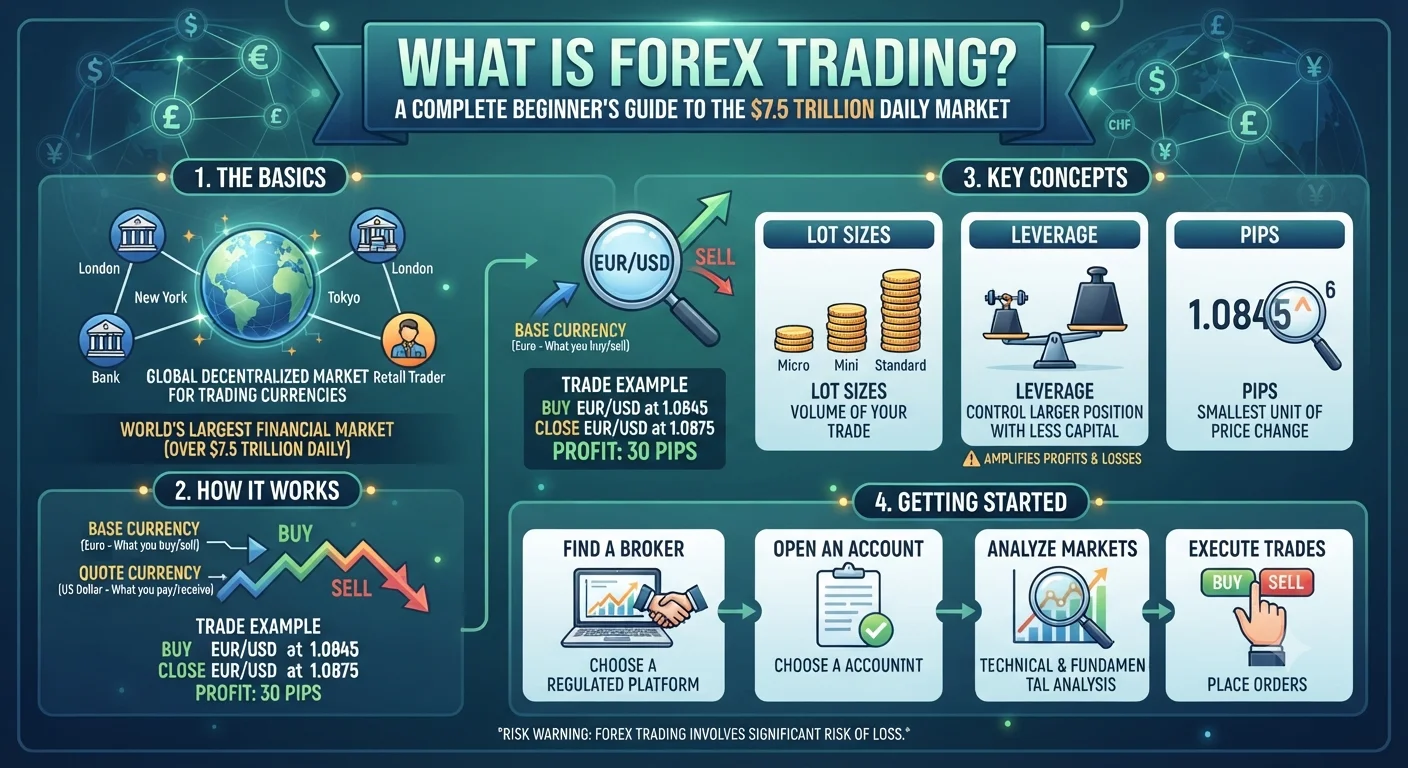
What Is Forex Trading? A Complete Beginner's Guide to the $7.5 Trillion Daily Market
Financial Disclaimer: This article is for educational purposes only and does not constitute financial advice. Forex trading carries significant risk of loss. Always consult a qualified financial advisor before trading.
If you have ever exchanged currency at an airport before an international trip, you have already participated in the foreign exchange market. Forex trading, at its core, is the act of buying one currency while simultaneously selling another. The goal is to profit from the change in value between those two currencies over time.
The forex market is the largest and most liquid financial market on the planet. According to the Bank for International Settlements (BIS) Triennial Survey, average daily trading volume in the global forex market reached approximately $7.5 trillion in 2022, and estimates for 2025 and 2026 place that figure even higher as retail participation continues to grow through mobile trading platforms and improved broker infrastructure across Asia, Africa, and Latin America.
Unlike the New York Stock Exchange or the London Stock Exchange, forex has no central trading floor. It operates as an over-the-counter (OTC) market, meaning all transactions happen directly between participants through an electronic network of banks, brokers, and financial institutions. This network operates 24 hours a day, five days a week, spanning trading sessions from Sydney to Tokyo, London, and New York.
What Is the Foreign Exchange Market and How Does It Work?
- What Is Forex Trading? A Complete Beginner's Guide to the .5 Trillion Daily Market
- What Is the Foreign Exchange Market and How Does It Work?
- Who Are the Main Participants in the Forex Market?
- How Are Currency Pairs Quoted and Priced?
- What Are Pips, Lots, and Leverage in Forex Trading?
- How to Open Your First Forex Demo Account Step by Step
- Key Takeaways for Beginner Forex Traders in 2026
The foreign exchange market, commonly abbreviated as forex or FX, is a global decentralized marketplace where currencies are traded. Every time a government imports goods, a corporation repatriates overseas profits, or a traveler exchanges money, a forex transaction takes place. These real-world needs for currency exchange, combined with speculative trading by banks, hedge funds, and individual traders, create the enormous daily volume that makes forex the most traded market in the world.
Forex operates through a tiered structure. At the top sits the interbank market, where the world's largest financial institutions, including JPMorgan Chase, Deutsche Bank, Citigroup, and UBS, trade enormous blocks of currency with each other. Below that tier sit institutional clients, hedge funds, pension funds, and multinational corporations. At the bottom of the hierarchy, but increasingly significant in 2026, are retail traders like you, who access the market through online brokers that aggregate prices from multiple interbank sources.
The market runs in four main sessions throughout the trading day. The Sydney session opens first, followed by Tokyo, then London, and finally New York. The most active trading period happens when the London and New York sessions overlap, typically between 13:00 and 17:00 GMT. During this window, liquidity peaks, spreads narrow, and currency pairs experience their largest intraday price movements.
Who Are the Main Participants in the Forex Market?
Understanding who moves the forex market is crucial for any beginner because these participants create the price action that every trader attempts to profit from.
Central Banks are the most powerful participants. Institutions such as the US Federal Reserve, the European Central Bank (ECB), the Bank of England (BOE), and the Bank of Japan (BOJ) influence currency values through interest rate decisions, quantitative easing programs, and direct market interventions. When the Federal Reserve raised interest rates aggressively through 2022 and 2023, the US Dollar strengthened significantly against most major currencies. In 2025 and into 2026, the Fed's pivot toward rate cuts has created a more balanced environment across major currency pairs.
Commercial and Investment Banks account for the largest share of daily forex volume. These institutions trade on behalf of clients and also speculate with their own capital. Their trading desks process enormous transaction volumes and often set the tone for short-term price direction.
Hedge Funds and Institutional Investors use forex for speculation and for hedging exposure in international portfolios. These participants can move markets, particularly in emerging market currencies, when they shift large positions.
Corporations trade forex to hedge against the currency risk inherent in international business. An American company paying suppliers in euros, for example, will purchase euros on the forex market, creating genuine demand for that currency.
Retail Traders now represent a growing slice of daily volume. Improved access through regulated brokers, mobile trading applications, and educational resources has brought millions of individual traders into the market across 2024, 2025, and 2026. While retail traders collectively represent a fraction of total institutional volume, modern retail platforms provide direct access to tight spreads and real-time pricing that was unavailable to individuals just a decade ago.
How Are Currency Pairs Quoted and Priced?
Every forex trade involves two currencies: the base currency and the quote currency. These are always expressed together as a pair. EUR/USD, for example, represents the euro (base) against the US dollar (quote). When the EUR/USD price is 1.0850, it means one euro buys 1.0850 US dollars.
Forex prices are quoted with two values: the bid price (the price at which your broker will buy the base currency from you) and the ask price (the price at which your broker will sell the base currency to you). The difference between these two prices is called the spread. Spreads are measured in pips.
Recommended Articles
 FOREX TRADING
 FOREX TRADING
 FOREX TRADING
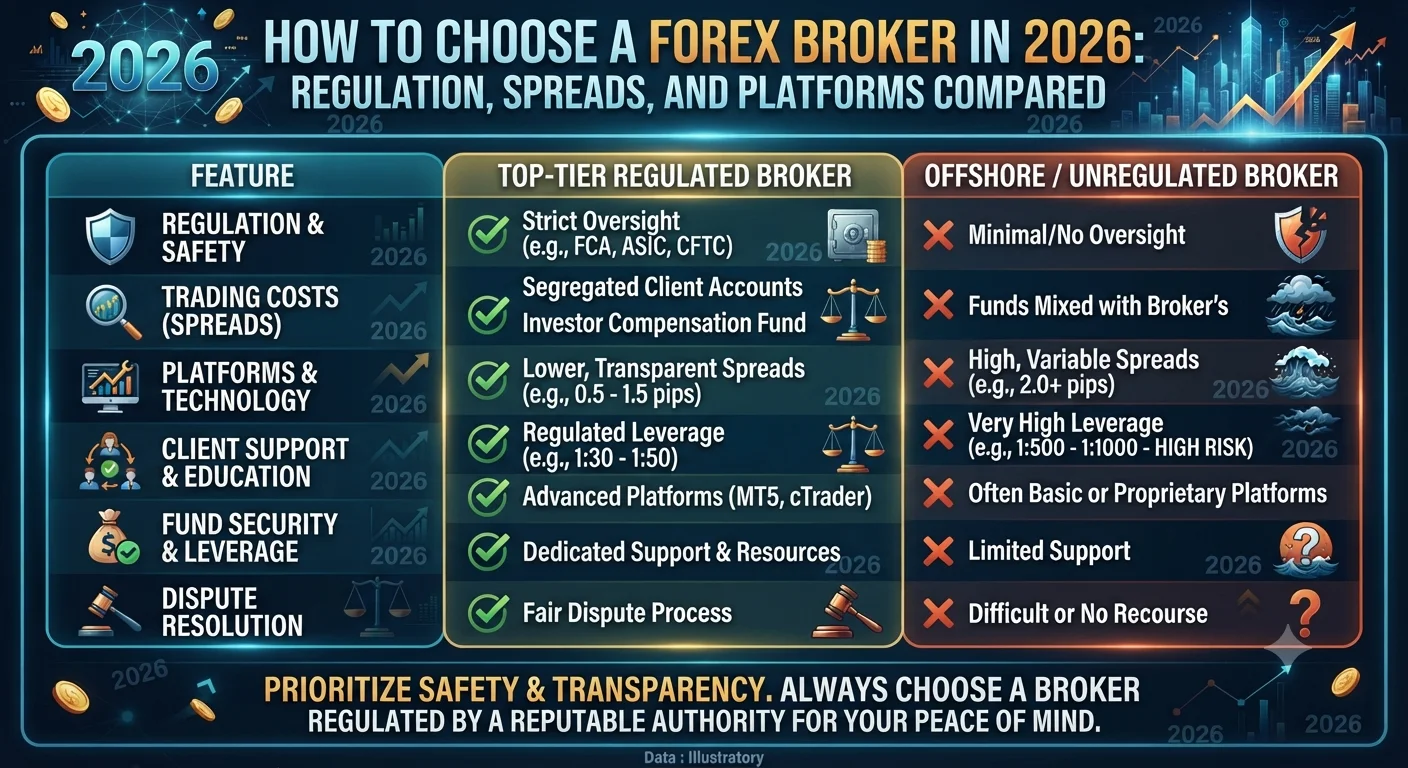
As of mid-2026, EUR/USD typically trades with a raw spread of 0.1 to 0.3 pips at ECN brokers during peak liquidity hours, reflecting the continued advancement of electronic market-making technology. Market maker brokers may quote spreads of 0.8 to 1.5 pips on the same pair, bundling their compensation into the spread rather than charging a separate commission.
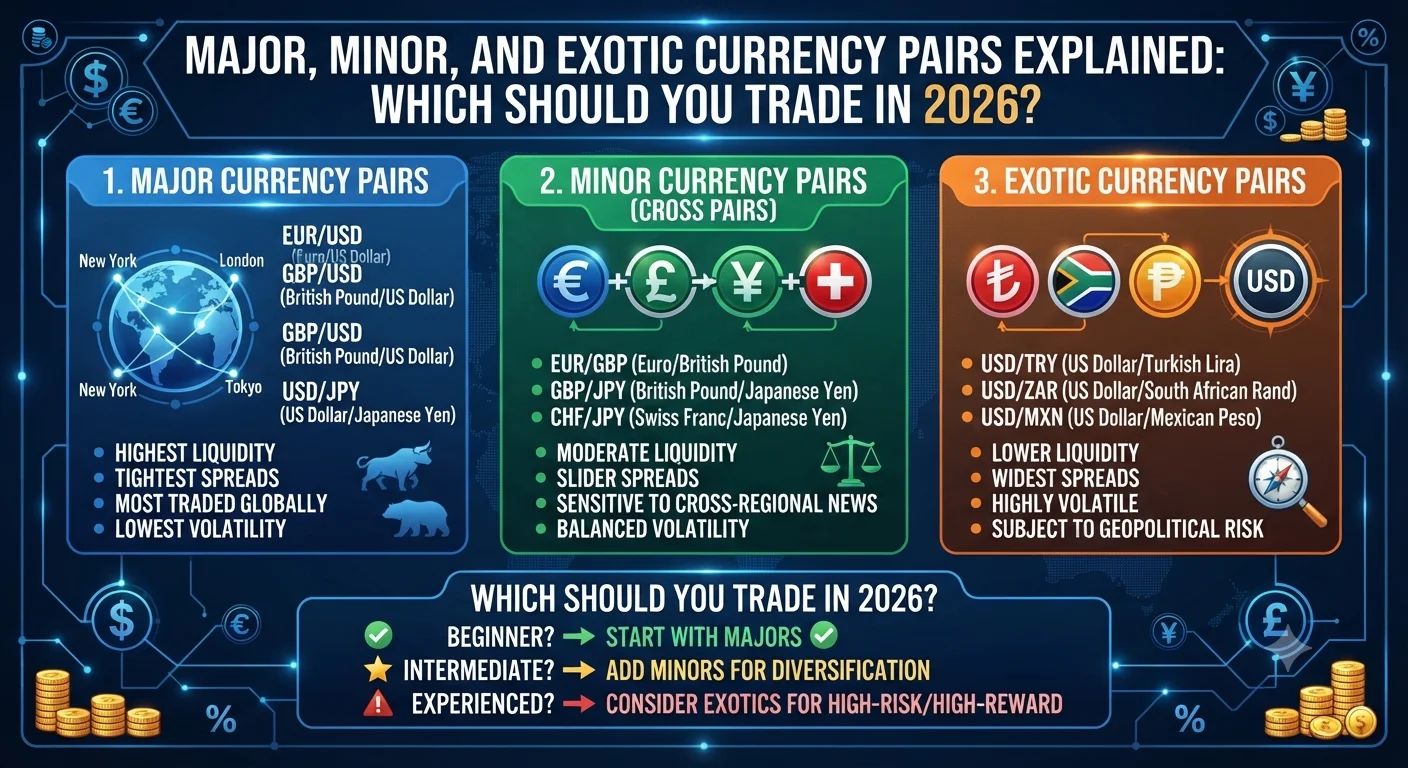
Currency pairs are grouped into three categories. Major pairs include the seven most-traded pairs, all involving the US dollar: EUR/USD, GBP/USD, USD/JPY, USD/CHF, AUD/USD, USD/CAD, and NZD/USD. These pairs account for roughly 75% of all forex trading volume. Minor pairs do not include the US dollar but combine other major currencies such as EUR/GBP, EUR/JPY, and GBP/JPY. Exotic pairs combine a major currency with the currency of an emerging or smaller economy, such as USD/TRY (Turkish lira) or USD/ZAR (South African rand).
What Are Pips, Lots, and Leverage in Forex Trading?
A pip (percentage in point) is the smallest standardized price movement in a currency pair. For most pairs, one pip equals 0.0001, or the fourth decimal place. For pairs involving the Japanese yen, one pip equals 0.01, or the second decimal place. If EUR/USD moves from 1.0850 to 1.0855, it has moved 5 pips.
Some brokers now quote prices to a fifth decimal place (called a pipette or fractional pip), giving finer granularity in pricing. This is standard practice among the top ECN and STP brokers operating in 2026.
A lot is the standard unit of trade size in forex. One standard lot equals 100,000 units of the base currency. Because most retail traders cannot afford to buy 100,000 units of a currency outright, brokers offer smaller sizes: one mini lot equals 10,000 units, one micro lot equals 1,000 units, and some brokers even offer nano lots of 100 units, making forex genuinely accessible for traders starting with small capital.
Leverage is the mechanism that allows traders to control a position larger than their actual account balance. If your broker offers 1:30 leverage (the maximum allowed for retail clients by the FCA and ESMA in 2026), you can control a $30,000 position with just $1,000 in your account. This amplifies both potential profits and potential losses proportionally. A 1% move in your favor on a leveraged position might return 30% of your margin, but a 1% move against you results in the same loss relative to your deposit. Leverage is a tool that demands respect and proper risk management before it is ever applied.
How to Open Your First Forex Demo Account Step by Step
A demo account is a practice trading environment provided by forex brokers at no cost. It uses real market prices and real trading mechanics but operates with virtual money. Every serious forex educator in 2026 recommends that new traders practice on a demo account for a minimum of three months before risking real capital.
Step 1: Choose a regulated broker. In 2026, the leading regulatory bodies for retail forex brokers include the Financial Conduct Authority (FCA) in the United Kingdom, the Australian Securities and Investments Commission (ASIC), and the Cyprus Securities and Exchange Commission (CySEC). These regulators enforce segregated client funds, capital adequacy requirements, and transparent pricing. Verify any broker's regulatory status directly on the regulator's official website before providing personal information.
Step 2: Complete the registration form. Regulated brokers require basic personal information including your name, email, address, and date of birth. This information is required under Know Your Customer (KYC) regulations that apply to all regulated financial services firms globally.
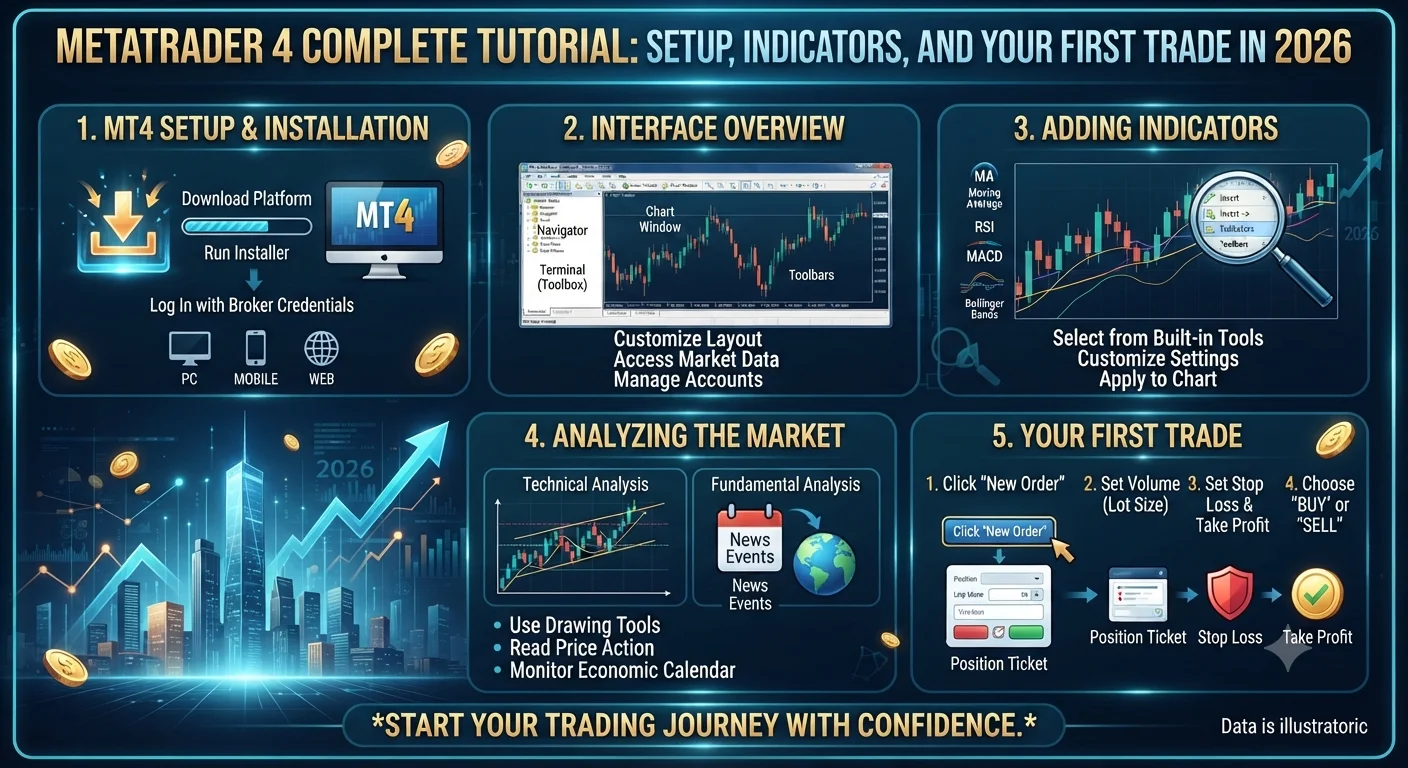
Step 3: Download the trading platform. MetaTrader 4 (MT4) remains the most widely used forex trading platform in 2026, with MetaTrader 5 (MT5) growing rapidly due to its improved charting and broader asset coverage. Many brokers now also offer proprietary web-based platforms. Install the platform on your desktop or download the mobile application for iOS or Android.
Step 4: Log in with your demo account credentials. Your broker will email login details for your demo account server, including the server name, account number, and password.
Step 5: Familiarize yourself with the interface. Place your first practice trades, experiment with chart timeframes, add basic indicators such as moving averages and RSI, and practice opening and closing positions. Focus on understanding the mechanics before worrying about profitability.
Step 6: Trade consistently on demo for at least 60 to 90 days. Track every trade in a spreadsheet or trading journal. Record your entry price, stop loss, take profit, result, and reasoning. This data becomes the foundation of your performance analysis when you eventually transition to live trading.
Key Takeaways for Beginner Forex Traders in 2026
The forex market is the world's most traded financial market with over $7.5 trillion in daily volume. It operates through a decentralized global network of banks, institutions, and retail brokers 24 hours a day, five days per week. Currency pairs are priced as a ratio between two currencies, and price movements are measured in pips. Lot sizes allow traders at all capital levels to participate. Leverage amplifies exposure but must be used responsibly within a strict risk management framework.
The single most important action any new trader can take in 2026 is to open a demo account, practice consistently for three months, and build genuine competence before committing real money to any trade.