Quick Answer
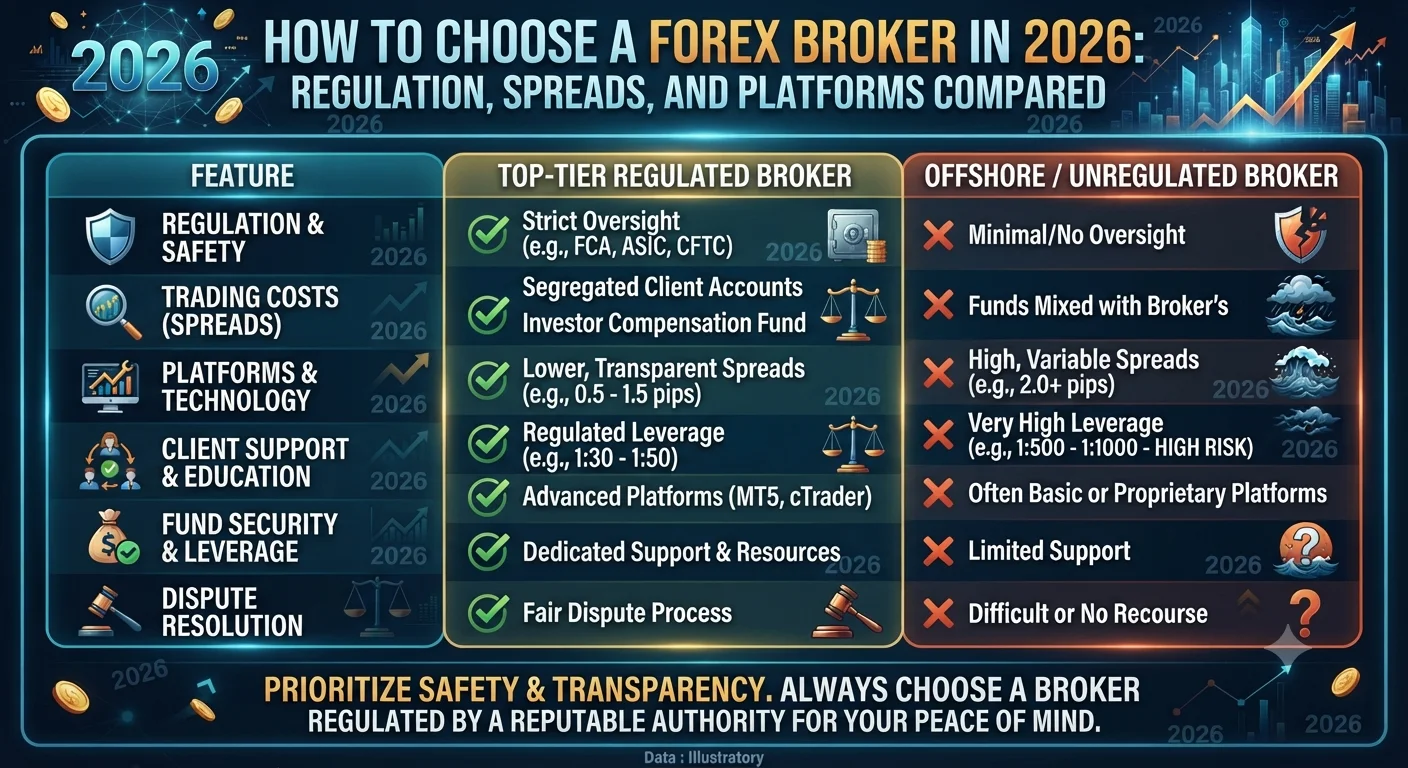
Choosing a forex broker in 2026 requires evaluating five core criteria: regulatory status and jurisdiction, account type and execution model, trading costs including spreads and commissions, platform quality and available instruments, and deposit and withdrawal reliability. The most important of these is regulation. A broker regulated by the FCA in the United Kingdom, ASIC in Australia, or CySEC in the European Union operates under mandatory client fund segregation, capital adequacy requirements, and compensation schemes that protect traders in the event of broker insolvency. No trading cost advantage offered by an unregulated offshore broker justifies the counterparty risk of trading with one.
What Makes a Forex Broker Trustworthy? Key Regulatory Bodies Explained
- Quick Answer
- What Makes a Forex Broker Trustworthy? Key Regulatory Bodies Explained
- ECN Versus STP Versus Market Maker Brokers: Which Is Best for You?
- Comparing Spreads and Commissions Across Top Forex Brokers in 2026
- MetaTrader 4 Versus MetaTrader 5 Versus cTrader: Platform Breakdown
- How to Test a Broker with a Demo Account Before Depositing
- Key Takeaways on Forex Broker Selection in 2026
Regulatory oversight is the single most important factor in forex broker selection because it determines the legal protections available to you as a client. A regulated broker is subject to ongoing supervision, mandatory financial reporting, client fund segregation from company operating funds, and in many jurisdictions, client compensation schemes that protect deposits up to a defined limit if the broker becomes insolvent.
Financial Conduct Authority (FCA), United Kingdom The FCA is widely considered the gold standard of forex broker regulation globally. FCA-regulated brokers are required to segregate all client funds in separate bank accounts, maintain minimum capital requirements, publish audited financial statements, and participate in the Financial Services Compensation Scheme (FSCS), which protects eligible client deposits up to £85,000 per person in the event of broker failure. In 2026, the FCA also enforces a maximum leverage limit of 1:30 for major currency pairs and 1:20 for minor pairs for retail clients, following ESMA guidelines. Verifying FCA regulation is straightforward: visit the FCA Register at register.fca.org.uk and search the broker's exact registered name.
Australian Securities and Investments Commission (ASIC), Australia ASIC regulation is the second most respected tier of global forex broker oversight. Australian-regulated brokers must hold an Australian Financial Services License (AFSL), maintain minimum net tangible assets, and segregate client funds. ASIC enforces the same 1:30 maximum leverage limit for retail clients as the FCA and applies similar product intervention powers to prevent misleading marketing practices. ASIC-regulated brokers include IC Markets, Pepperstone, and FP Markets, all of which have grown significantly in 2025 and 2026 as their ECN execution models gained recognition among professional retail traders.
Cyprus Securities and Exchange Commission (CySEC), European Union CySEC-regulated brokers operate under EU law through the Markets in Financial Instruments Directive (MiFID II framework, updated to MiFID III processes in 2025). CySEC regulation provides access to the EU Investor Compensation Fund, which covers eligible clients up to €20,000. While CySEC provides genuine regulatory oversight, the compensation limit is lower than the FCA's FSCS, and historically some CySEC-regulated brokers have operated with less rigorous enforcement than FCA counterparts. Always verify the specific broker's track record and client reviews in addition to its regulatory status.
Offshore Regulators: FSA Seychelles, IFSC Belize, Vanuatu Offshore-regulated brokers are not recommended for retail traders in 2026 under any circumstances. These jurisdictions offer registration with minimal capital requirements, no meaningful client fund protection, no compensation schemes, and limited enforcement capability. Offshore brokers often advertise high leverage of 1:500 or higher as an attraction, but this leverage is available precisely because there are no consumer protection regulations preventing it. The FTX collapse in 2022, while a crypto exchange rather than a forex broker, illustrated the catastrophic consequences of placing funds with an offshore-registered financial entity outside meaningful regulatory jurisdiction.
ECN Versus STP Versus Market Maker Brokers: Which Is Best for You?
Understanding broker execution models is essential because they directly determine whether your broker has a conflict of interest with your trading success.
Electronic Communications Network (ECN) Brokers ECN brokers route client orders directly to a network of liquidity providers including banks, hedge funds, and other financial institutions. The broker earns revenue through a commission charged per trade (typically $3 to $7 per standard lot round trip) rather than from the spread itself. Because ECN brokers earn fixed commissions regardless of whether clients win or lose, they have no financial incentive for clients to lose trades. Raw spreads on ECN accounts for EUR/USD in 2026 start from 0.0 to 0.3 pips during peak liquidity hours, making them the lowest-cost option for active traders who trade sufficient volume to justify the per-trade commission.
- Major, Minor, and Exotic Currency Pairs Explained: Which Should You Trade in 2026?
- What Is Forex Trading? A Complete Beginners Guide to the $7.5 Trillion Daily Market
ECN execution is also faster and more transparent than other models. Orders are filled at the best available price from the liquidity pool, meaning slippage during normal market conditions is minimal. During high-impact news events, ECN spreads widen to reflect genuine interbank liquidity conditions rather than being artificially held narrow and then gapped.
Straight Through Processing (STP) Brokers STP brokers route orders directly to liquidity providers without a dealing desk, similar to ECN brokers, but typically work with a smaller panel of liquidity providers rather than a full network. STP brokers add a small markup to the spread they receive from liquidity providers as their revenue model. This means STP spreads are slightly wider than raw ECN spreads but typically involve no additional per-trade commission. For traders with smaller accounts who find per-trade commissions disproportionately impactful relative to their position sizes, STP accounts can be more cost-effective than ECN at low trading volumes.
Market Maker Brokers Market maker brokers take the opposite side of client trades internally rather than passing orders to external liquidity. When a client buys EUR/USD at a market maker broker, the broker itself sells EUR/USD to that client. The broker profits when the client loses and loses when the client profits, creating a direct conflict of interest.
This does not mean market maker brokers are fraudulent. Legitimate market maker brokers hedge their aggregate client exposure in the real market and manage risk carefully. However, the structural conflict of interest means that market makers have regulatory restrictions on practices like stop hunting (artificially spiking prices to trigger client stop losses) and requoting (changing the fill price after a client's order is submitted). In 2026, FCA and ASIC-regulated market makers must comply with best execution requirements, which limit the most egregious abuses of the model.
Recommended Articles
 FOREX TRADING
 FOREX TRADING
 FOREX TRADING
Market maker brokers typically offer fixed or near-fixed spreads, no commissions, and simpler account structures. They are most appropriate for beginners learning the mechanics of trading and for traders with very small accounts where the minimum commission structure of ECN accounts would be disproportionate. As account size and trading volume grow, transitioning to an ECN account becomes increasingly beneficial.
Comparing Spreads and Commissions Across Top Forex Brokers in 2026
Trading costs are the ongoing tax on every trade you place. Over hundreds or thousands of trades annually, the difference between a high-cost and low-cost broker compounds into a meaningful performance differential.
The total cost of a trade at any broker is the sum of the spread and any per-trade commission, both expressed in pips or dollars per standard lot for comparison purposes.
At a top-tier ECN broker such as IC Markets (ASIC regulated) or Pepperstone (FCA and ASIC regulated) in 2026, EUR/USD raw spreads average 0.1 to 0.2 pips with a commission of approximately $3.50 per side ($7.00 round trip) per standard lot. Converting the commission to pip equivalent: on EUR/USD where one pip equals $10 per standard lot, $7.00 equals 0.7 pips. Total effective cost: approximately 0.8 to 0.9 pips per round-trip trade.
At a standard STP broker, EUR/USD spreads typically average 0.8 to 1.2 pips with no commission. Total effective cost: 0.8 to 1.2 pips per round-trip trade.
At a market maker broker, EUR/USD spreads typically range from 1.0 to 1.8 pips with no commission. Total effective cost: 1.0 to 1.8 pips per round-trip trade.
For a trader placing 10 standard lots per day over 20 trading days per month, the monthly cost difference between a 0.9-pip total cost broker and a 1.5-pip total cost broker is 0.6 pips times 10 lots times $10 per pip times 20 days, which equals $1,200 per month or $14,400 per year in additional trading costs. This arithmetic makes broker cost comparison a financially significant exercise rather than a minor administrative decision.
MetaTrader 4 Versus MetaTrader 5 Versus cTrader: Platform Breakdown
The trading platform is the interface through which every analysis decision becomes an executed trade. Platform quality affects execution speed, charting capability, order management, and the overall trading experience.
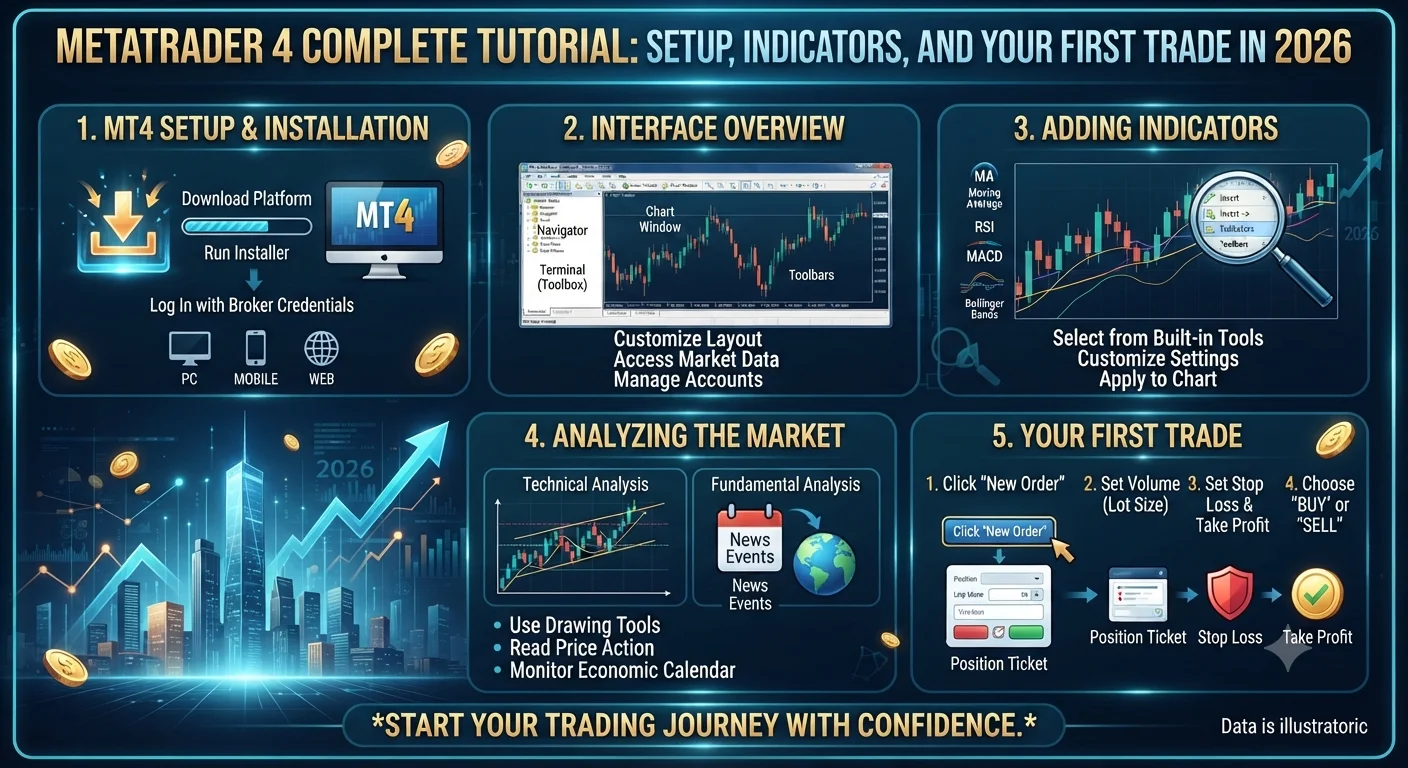
MetaTrader 4 (MT4) MT4 remains the most widely used retail forex trading platform globally in 2026, despite being originally released in 2005. Its longevity reflects genuine utility: MT4 offers a clean, stable charting interface with 30 built-in indicators, 9 timeframes, one-click trading, and a vast library of custom indicators and Expert Advisors (automated trading robots) developed by its global user community over two decades. MetaTrader 4's MQL4 programming language allows traders to build custom indicators and automated strategies without advanced programming knowledge. The platform is available as a desktop application for Windows (via WINE on Mac), as a mobile application for iOS and Android, and as a web-based version accessible from any browser.
MetaTrader 5 (MT5) MT5 is the successor to MT4, offering additional timeframes (21 versus MT4's 9), more order types (including Buy Stop Limit and Sell Stop Limit), a built-in economic calendar, improved strategy tester with multi-currency backtesting capability, and access to equities and futures in addition to forex through compatible brokers. MT5 uses the MQL5 programming language, which is more powerful than MQL4 but also more complex. In 2026, MT5 adoption has accelerated as brokers expand their instrument offerings beyond forex into CFDs on stocks, indices, and commodities, for which MT5's broader architecture is better suited. However, MT4's larger existing indicator and EA library means it retains a meaningful advantage for traders who rely on community-developed tools.
cTrader cTrader is the platform of choice for ECN-focused brokers including Pepperstone and IC Markets in 2026 and is increasingly recognized as the most sophisticated retail trading platform available. Key advantages over MetaTrader include superior order management with detachable charts, a more intuitive Level 2 order book display, faster one-click execution, better backtesting through cTrader Automate, and a cleaner visual design that many professional traders prefer. cTrader's cAlgo programming environment allows automated strategy development in C#, a more widely used programming language than MQL4 or MQL5. For serious traders who value execution quality and platform sophistication, cTrader is the premium choice in 2026.
How to Test a Broker with a Demo Account Before Depositing
The demo account testing process should be systematic rather than casual. A demo account is not just practice for strategy development. It is also a quality assessment of the broker itself.
During the demo period, evaluate the following broker-specific factors. Execution speed: place market orders during high-liquidity hours and note the time between order submission and confirmation. At top ECN brokers in 2026, execution should be confirmed within 50 to 150 milliseconds. Requoting frequency: on the MT4 or MT5 platform, note whether you receive requotes (messages asking whether you accept a new price after submitting an order) more than very occasionally. Frequent requotes indicate poor execution infrastructure.
Spread behavior during news: check live spreads during a medium-impact news release. At a quality broker, EUR/USD spreads should widen temporarily during the release and return to normal within seconds. At a poor-quality broker, spreads may remain wide for minutes or artificially narrow spreads may mask execution at worse prices.
Withdrawal testing: after the demo period, make a small initial deposit and immediately test the withdrawal process. The withdrawal experience with small amounts is the most reliable indicator of how a broker will handle larger withdrawals. Delays, unexpected documentation requirements, or unexplained processing fees on a small withdrawal should be treated as serious warning signs before committing significant capital.
Key Takeaways on Forex Broker Selection in 2026
Regulation by the FCA, ASIC, or CySEC is non-negotiable and the first filter to apply in any broker evaluation. The broker's execution model determines whether conflicts of interest exist between the broker's revenue and your trading success. Total trading cost comparison including spread plus commission reveals the true ongoing cost of trading with each broker. MT4 remains the most accessible platform for beginners while MT5 and cTrader offer advanced features for experienced traders. Always test execution quality, spread behavior, and withdrawal processing with a small amount before committing significant capital, regardless of how established the broker appears.