Forex Risk Management: The Number One Rule That Separates Profitable Traders from Losers
Financial Disclaimer: This content is purely educational and does not constitute financial advice. Forex trading involves substantial risk of capital loss. All examples are for illustrative purposes only.
You can have the most sophisticated trading strategy in the world. You can correctly predict market direction with remarkable accuracy. You can have access to the best broker, the most powerful charting tools, and the deepest fundamental analysis. None of it will matter if you do not practice sound risk management. Risk management is not a supporting element of successful forex trading. It is the foundation upon which everything else rests.
The most critical and counterintuitive truth about professional trading is this: how you manage losing trades matters far more than the accuracy of your entries. Professional traders at top-tier hedge funds often operate with win rates of 40 to 50%, meaning they lose more trades than they win. Yet they generate consistent profits because their winning trades return significantly more than their losing trades cost. This asymmetry between the size of losses and the size of gains is the mathematical engine of long-term trading profitability, and it is entirely created and controlled through risk management.
Why Do 70 to 80% of Retail Forex Traders Lose Money?
- Forex Risk Management: The Number One Rule That Separates Profitable Traders from Losers
- Why Do 70 to 80% of Retail Forex Traders Lose Money?
- What Is the 1% Risk Rule and How Do You Apply It?
- How to Calculate Position Size Based on Account Balance
- Stop Loss Placement Strategies That Actually Work
- Building a Risk Management Plan Before Your First Live Trade
- Key Takeaways on Forex Risk Management for 2026 Traders
The percentage of retail forex traders who lose money over any meaningful time period has been a consistent figure across regulatory disclosures for over a decade. In 2026, FCA-regulated brokers in the United Kingdom are required to publish loss rates on their websites. Across major regulated brokers, the proportion of retail client accounts losing money ranges from 65% to 82% depending on the broker, the time period measured, and the asset class.
ESMA (European Securities and Markets Authority) data, published through its annual retail investor working papers, consistently identifies three primary causes of retail losses: overleveraging (using position sizes far too large relative to account equity), the absence of stop losses (allowing losing trades to run without a predetermined exit), and emotional decision-making (deviation from any planned approach based on fear, greed, or frustration).
All three causes share a common root: inadequate risk management. Overleveraging is a risk sizing failure. Absent stop losses are exit rule failures. Emotional trading is often a consequence of the first two: when a trader has more money at risk than they can afford to lose, every market fluctuation becomes psychologically intolerable, leading to irrational decisions.
The antidote to all three is a structured, rule-based risk management framework applied before every single trade.
What Is the 1% Risk Rule and How Do You Apply It?
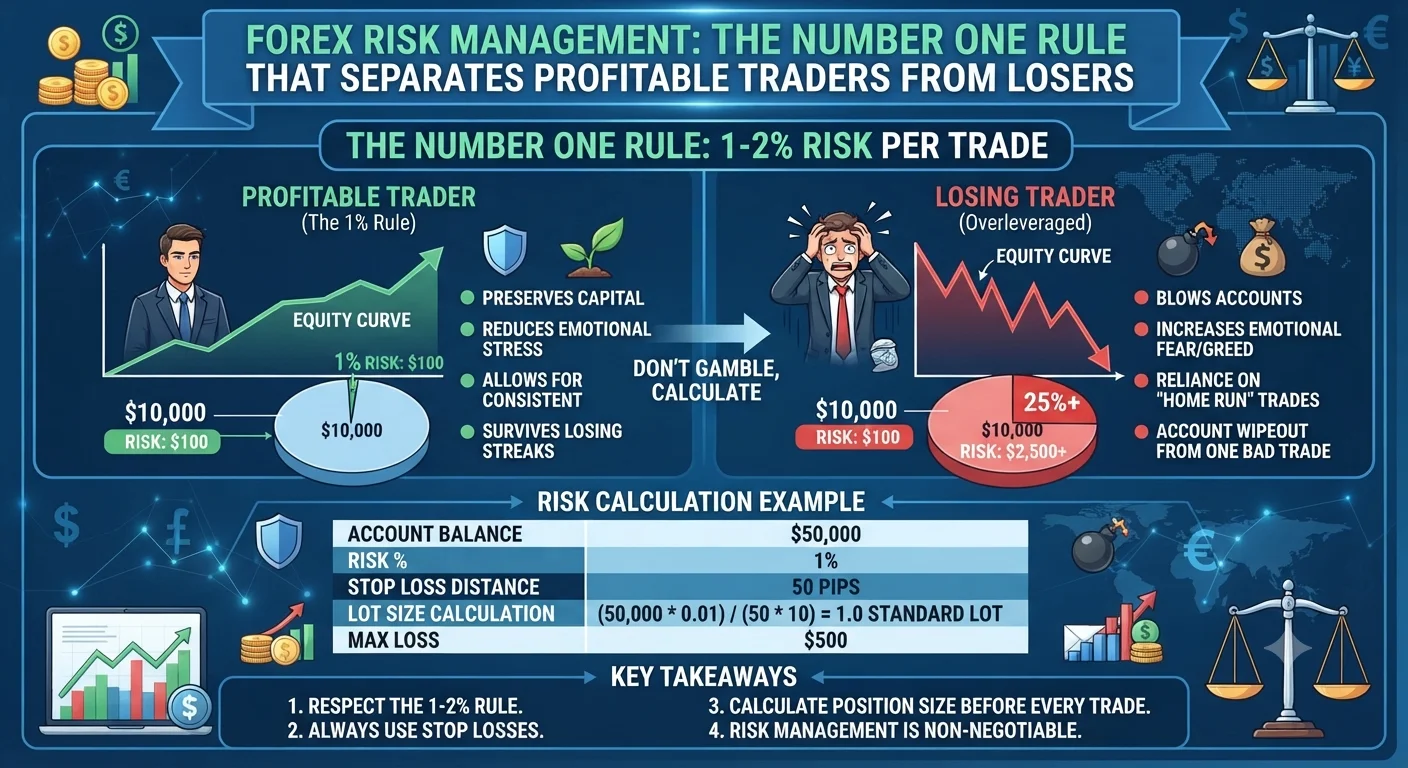
The 1% risk rule is the cornerstone of retail forex risk management. It states that no single trade should put more than 1% of your total account equity at risk of loss.
The elegance of this rule lies in its mathematical protection. If you lose 1% of your account on every trade, you would need to have 100 consecutive losing trades with no winners to lose your entire account. While no strategy produces 100 consecutive losses, the practical implication is that even a severe losing streak of 20 consecutive losing trades (an almost statistically impossible outcome for a properly backtested strategy) would reduce a $10,000 account by only $1,813, assuming each loss is calculated on the reduced equity. The account survives. The trader survives. The strategy can continue to be deployed.
Compare this to a trader risking 10% per trade. Ten consecutive losses (a realistic outcome during drawdown periods for many strategies) would reduce that same $10,000 account to approximately $3,487 and require a 187% return just to recover. More commonly, the psychological pressure of such a drawdown causes traders to deviate from their strategy, compound their errors, and ultimately abandon trading entirely.
Applying the 1% rule in practice:
For a $5,000 trading account, the maximum risk per trade is $50. For a $10,000 account, the maximum risk per trade is $100. For a $25,000 account, the maximum risk per trade is $250.
This dollar risk figure is your non-negotiable loss limit on any single trade. The stop loss you place defines how many pips your trade can move against you before it closes. Your position size is then calculated to ensure that if the stop is hit, exactly $50 (or $100, or $250) is lost, not a dollar more.
Many professional traders, particularly those in prop firm environments in 2026 where funding rules are strict, choose to risk 0.5% per trade for added resilience during drawdown periods. The 1% figure is a ceiling, not a target.
How to Calculate Position Size Based on Account Balance
Position sizing is the calculation that links your account risk amount to your actual trade size. It answers the question: given that I can only lose $100 on this trade and my stop loss is 50 pips away, how many lots should I trade?
The formula is straightforward:
Position size (in lots) = Account risk in dollars divided by (stop loss in pips multiplied by pip value per standard lot)
For most USD-quoted pairs such as EUR/USD and GBP/USD, the pip value per standard lot is $10. For USD-based pairs where the dollar is the base currency (such as USD/JPY), the pip value per standard lot varies and must be calculated from the current exchange rate.
Worked example: Account size: $10,000 Risk per trade: 1% = $100 Stop loss distance: 40 pips Pip value per standard lot: $10
Recommended Articles
 RISK MANAGEMENT
Position size = $100 divided by (40 pips multiplied by $10) = $100 divided by $400 = 0.25 standard lots (or 2.5 mini lots or 25 micro lots)
If the trade hits the stop loss, the loss equals 40 pips multiplied by 0.25 lots multiplied by $10 per pip = $100. Exactly 1% of the account, as planned.
If the trade hits a take profit at 80 pips (a 1:2 risk-reward ratio), the profit equals 80 pips multiplied by 0.25 lots multiplied by $10 = $200. The account grows by 2% on a winning trade while only risking 1% on a losing one.
In 2026, most trading platforms including MetaTrader 4, MetaTrader 5, TradingView's broker integrations, and cTrader provide built-in position size calculators. Standalone position size calculators are also widely available as free browser tools and mobile applications. There is no excuse in 2026 for manually estimating position sizes or guessing lot sizes when the calculation takes under 30 seconds with any of these tools.
Stop Loss Placement Strategies That Actually Work
The stop loss is an order placed with your broker that automatically closes your trade at a specific price if the market moves against you. It is your predefined exit from a losing trade and the mechanism that enforces the 1% risk rule. Trading without a stop loss is not a strategy. It is a form of financial self-harm that exposes the entire account to catastrophic loss from a single adverse move.
There are five primary methods of stop loss placement used by professional traders, each suited to different trading styles and strategies.
Structure-based stops are placed behind significant price levels: below a recent swing low for long trades, or above a recent swing high for short trades. This is the most professionally recommended method because it places the stop beyond levels where market structure would be invalidated. If price trades through a key support level that you expected to hold for your long trade, the trade thesis is simply wrong, and the stop should be there to close it.
ATR-based stops use the Average True Range indicator to set stop distance proportional to current market volatility. If the ATR on the four-hour EUR/USD chart reads 45 pips, a stop placed 1.5 times ATR away (67.5 pips) accounts for normal market volatility while still being breached only when an unusual move occurs. ATR-based stops automatically adapt to changing volatility conditions, widening during high-volatility news periods and tightening during quieter market phases.
Fixed pip stops place the stop a predetermined number of pips away from the entry regardless of market structure or volatility. This is the simplest method but the least sophisticated. A 30-pip stop on EUR/USD might be perfectly appropriate on a calm Tuesday afternoon but dangerously tight on NFP release day when the pair routinely moves 50 to 100 pips within seconds of the data release.
Zone-based stops are used when trading from clearly defined supply or demand zones (a concept associated with institutional trading methods and widely used in 2026 among price action and Smart Money Concepts traders). The stop is placed beyond the far edge of the zone, accepting that if price trades fully through the zone, the zone has failed.
Time-based stops are less common but used by some day traders who define a specific time by which a trade must have moved in their direction. If the trade has not progressed after a defined period (such as four hours), it is closed regardless of P&L to avoid tying up margin in a stalled position.
Building a Risk Management Plan Before Your First Live Trade
A risk management plan is a written document (or a committed mental framework, for those who prefer it that way) that defines your risk parameters before you ever place a live trade. It should answer, at minimum, the following questions.
What percentage of your account will you risk per trade? The answer should be 0.5% to 1% for most retail traders in 2026 and should never exceed 2% under any circumstances for accounts under $100,000.
What is your maximum daily loss limit? Professional traders and prop firms in 2026 typically set daily loss limits of 3 to 5% of account equity. When this limit is hit, trading stops for the day. No exceptions. The daily limit exists because emotional state after a losing day is demonstrably impaired, and continuing to trade into further losses compounds errors.
What is your maximum weekly drawdown limit? A sensible weekly ceiling is 8 to 10% of account equity. If this is breached, a structured review of the trading strategy and recent trades should occur before live trading resumes.
What risk-reward ratio will you require before entering any trade? A minimum of 1:1.5 is the floor for most professional approaches, meaning you target at least 1.5 times your risk in potential profit on every trade. Most experienced traders use minimum ratios of 1:2 or 1:3, which allows them to remain profitable overall even with win rates below 50%.
How will you handle consecutive losses? Having a written rule for this prevents reactive, emotion-driven decisions. One useful rule: after three consecutive losing trades, reduce position size by 50% for the next five trades. This mechanical reduction preserves capital during a losing streak while keeping the trader engaged with the market at a smaller, less consequential size.
Key Takeaways on Forex Risk Management for 2026 Traders
Risk management is the most important skill in forex trading and the one most neglected by beginners. The data is clear: the majority of retail traders lose money, and the primary reason is inadequate risk management rather than poor strategy selection. The 1% risk rule, precise position sizing, structure-based stop placement, and a written risk management plan with daily and weekly loss limits form the complete framework every trader needs before placing a single live trade. Master this framework on a demo account until it is second nature. It is the foundation upon which any successful trading career in 2026 is built.