Quick Answer
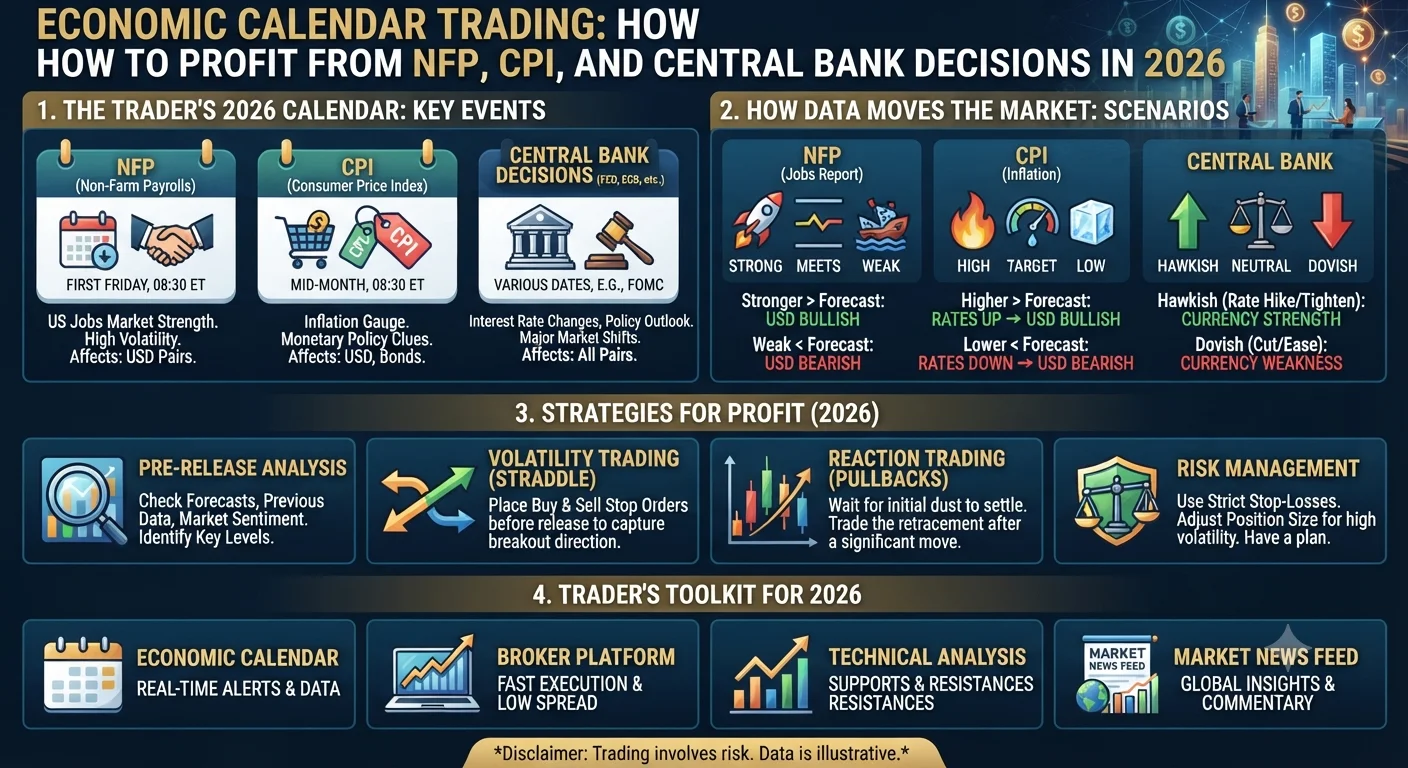
Economic calendar trading is the practice of anticipating and reacting to scheduled macroeconomic data releases and central bank decisions that have a measurable, often immediate impact on currency pair prices. In 2026, the three most market-moving categories of economic events are Non-Farm Payrolls (NFP), Consumer Price Index (CPI) inflation data, and central bank interest rate decisions from the Federal Reserve, European Central Bank, Bank of England, and Bank of Japan. These events are published on a fixed schedule months in advance, giving traders the opportunity to prepare systematic approaches rather than react impulsively to news in real time.
What Is the Economic Calendar and Which Events Move Markets Most?
- Quick Answer
- What Is the Economic Calendar and Which Events Move Markets Most?
- Non-Farm Payrolls: How to Trade the Biggest Monthly Forex Event
- CPI and Inflation Data: Why Central Banks Watch It So Closely
- Federal Reserve and ECB Decisions: Pre-Event Versus Post-Event Trading
- Building a News Trading Strategy with Strict Risk Controls
- Key Takeaways on Economic Calendar Trading in 2026
The economic calendar is a schedule of all upcoming macroeconomic data releases, central bank meetings, and significant economic announcements that are expected to affect financial markets. In 2026, the most widely used economic calendar resources include Forex Factory (forexfactory.com), Investing.com, DailyFX, and the Bloomberg Economic Calendar, all of which publish events weeks or months in advance with consensus forecasts, previous readings, and impact ratings.
Events on the economic calendar are typically classified by their expected market impact: low, medium, or high. High-impact events are those historically associated with the largest and most immediate price movements across currency pairs. For forex traders, understanding which specific releases carry high-impact status and why is the foundation of economic calendar trading.
In 2026, the highest-impact recurring events for major currency pairs are as follows. For USD pairs: the Non-Farm Payrolls report (first Friday of every month), the Consumer Price Index (monthly, mid-month), the Federal Open Market Committee (FOMC) interest rate decision and press conference (eight times per year), GDP advance estimates (monthly), and the ISM Manufacturing and Services PMI reports. For EUR pairs: the ECB rate decision and Lagarde press conference (eight times per year), eurozone CPI flash estimate, German IFO Business Climate, and eurozone GDP. For GBP pairs: the Bank of England Monetary Policy Committee decision (eight times per year), UK CPI, and UK labor market data. For JPY pairs: Bank of Japan policy decisions (eight times per year), Japanese CPI, and BOJ Governor press conferences, which have been particularly significant in 2025 and 2026 given the BOJ's gradual interest rate normalization process.
The economic calendar is best thought of as a weekly map of risk events. Before any trading week begins, identifying which high-impact events are scheduled allows traders to make informed decisions about which positions to hold through events and which to close before them.
Non-Farm Payrolls: How to Trade the Biggest Monthly Forex Event
The Non-Farm Payrolls report, published by the US Bureau of Labor Statistics on the first Friday of every month at 13:30 GMT, is the single most watched and most market-moving scheduled economic release in the forex world. The report measures the net number of paid US workers across all business sectors excluding farm workers, government employees, private household employees, and employees of nonprofit organizations. In 2026, monthly NFP readings have ranged from approximately 100,000 to 280,000 net jobs added, reflecting an economy that has transitioned from post-pandemic overheating to a more normalized labor market.
The market's reaction to NFP is driven primarily by the deviation between the actual result and the consensus forecast published by Bloomberg, Reuters, and Investing.com. A result that matches consensus exactly typically produces muted initial reaction followed by a gradual drift based on the secondary details in the report (unemployment rate, average hourly earnings, and prior month revisions). A result that significantly beats consensus (say, 280,000 actual versus 175,000 expected) typically produces immediate USD strength across all major pairs as markets price in a reduced probability of Fed rate cuts. A miss (100,000 actual versus 175,000 expected) produces immediate USD weakness.
The initial spike on NFP release is typically the largest single-candle move of the month for USD pairs, often 50 to 150 pips within the first one to five minutes following the 13:30 GMT release. Attempting to trade this initial spike is extremely high risk due to the near-instantaneous price movement, algorithm-driven execution, and extremely wide spreads that brokers apply during the spike period. Many retail brokers widen EUR/USD spreads to 5 to 20 pips during NFP release, making the cost of entering at the exact moment of release prohibitively expensive.
The most effective NFP trading approach for retail traders in 2026 is the post-spike fade or the post-spike continuation, both of which wait for the initial algorithmic reaction to complete before entering.
The post-spike continuation: After the initial NFP spike, price often continues in the direction of the surprise for 30 to 90 minutes as human traders and second-wave algorithms process the implications. A strong NFP beat producing an initial 80-pip USD rally often continues for an additional 50 to 100 pips over the following hour as the market fully digests the data. Entry is taken 10 to 15 minutes after the release once the initial volatility stabilizes, with a stop on the opposite side of the spike low or high.
The post-spike reversal (fade): In approximately 40 to 50% of NFP releases, the initial spike partially or fully reverses within 30 to 60 minutes. This reversal occurs because the initial algorithmic reaction overextends price before human traders step in to fade the extreme move. The fade is higher risk than the continuation because it requires correctly identifying when the spike has exhausted, but it can offer excellent entries at the extremes of the initial spike with tight stops.
CPI and Inflation Data: Why Central Banks Watch It So Closely
The Consumer Price Index (CPI) measures the average change in prices paid by consumers for a fixed basket of goods and services including food, housing, transportation, healthcare, and recreation. It is the primary measure of consumer-level inflation used by central banks in the United States, United Kingdom, eurozone, and most other developed economies to assess whether monetary policy settings are appropriate.
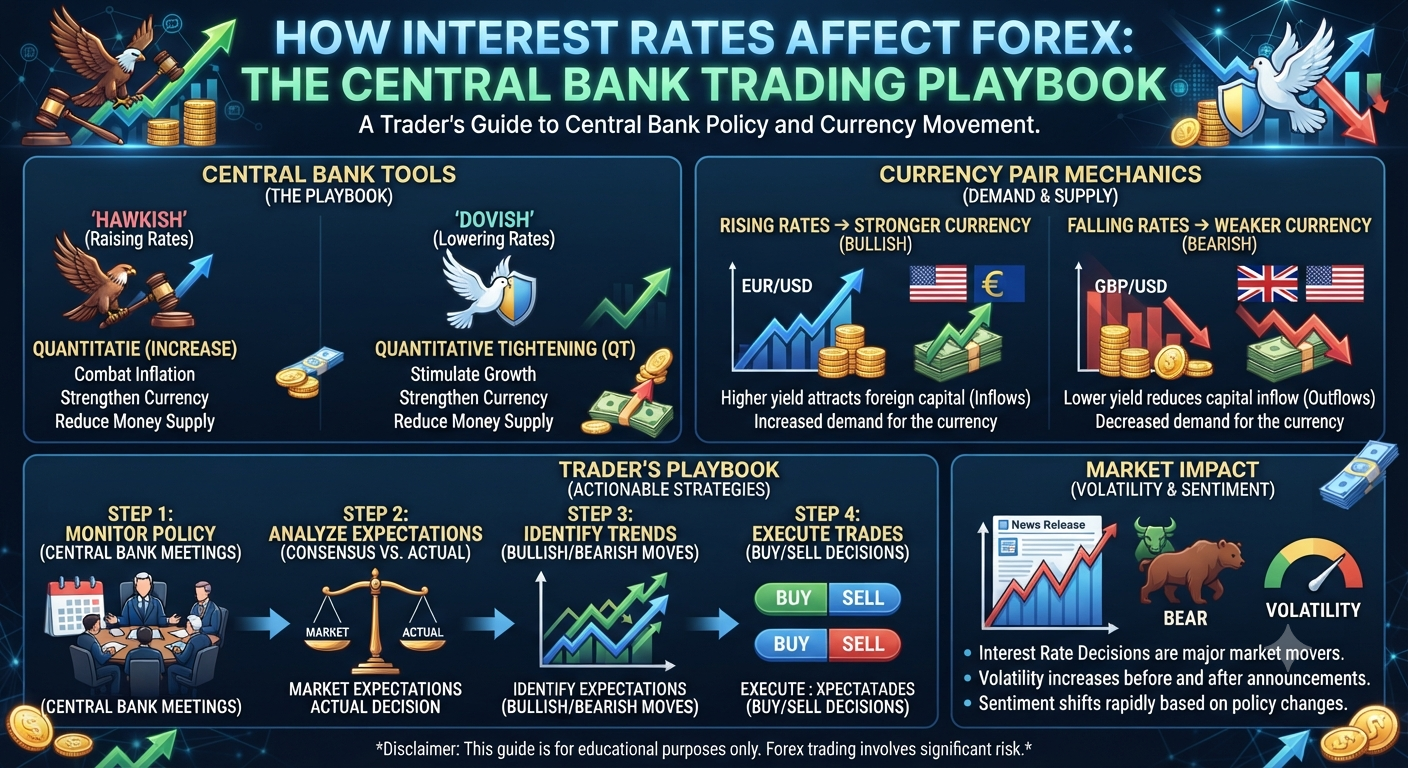
The relationship between CPI and central bank policy is direct and powerful: when CPI is persistently above a central bank's target (the Federal Reserve and ECB both target approximately 2% annual inflation), the central bank typically responds by raising interest rates to slow economic activity and reduce inflationary pressure. Higher interest rates make a currency more attractive to foreign investors seeking yield, driving demand for that currency and strengthening it on the forex market. Conversely, when CPI falls below target, central banks tend toward rate cuts, which weaken the currency as yield differentials become less favorable.
Recommended Articles
 MARKET NEWS ANALYSIS
In 2026, CPI data carries heightened market sensitivity because the global economy is navigating the aftermath of the 2021 to 2023 inflationary surge. While headline inflation in the United States has returned closer to the 2% target range, services inflation has remained stickier than the Federal Reserve initially projected, keeping markets sensitive to any upside surprise in monthly CPI prints that might delay the anticipated rate-cutting cycle.
US CPI is released monthly, typically on the second Tuesday of the month at 13:30 GMT, making it a recurring high-impact event for all USD pairs. Eurozone CPI flash estimates are released near the end of each month and typically impact EUR/USD, EUR/GBP, and EUR/JPY. UK CPI is released on Wednesday mornings at 07:00 GMT and is the primary scheduled driver of GBP pair movements on release day.
The trading approach for CPI is structurally similar to NFP: assess the consensus forecast, wait for the actual release, and trade the deviation rather than predicting the outcome. Avoid entering new positions within 30 minutes before the release to prevent being caught in pre-release positioning moves.
Federal Reserve and ECB Decisions: Pre-Event Versus Post-Event Trading
Central bank interest rate decisions are the highest-impact recurring events in the forex calendar, producing sustained multi-session directional moves rather than the brief spike-and-reverse patterns more characteristic of data releases like NFP and CPI.
The Federal Reserve's FOMC meets eight times per year (approximately every six weeks) and publishes its rate decision, updated economic projections (the dot plot), and a policy statement simultaneously at 19:00 GMT. Fed Chair Jerome Powell (or his successor) then conducts a press conference at 19:30 GMT that often produces additional volatility as the nuance of the Fed's thinking becomes clearer through the question-and-answer format.
The ECB meets on the same eight-times-per-year schedule and publishes decisions at 13:15 GMT, with President Christine Lagarde's press conference at 13:45 GMT. The ECB's decisions are the primary driver of EUR/USD direction on meeting days.
Pre-event positioning: In the days before a central bank decision, markets price in probabilities of different outcomes using interest rate futures and options data. Platforms including CME FedWatch (for the Fed) and OIS swap markets (for the ECB and BOE) publish implied probability percentages for each possible outcome in real time. When the market is pricing in a 90% probability of a 25-basis-point cut, the cut itself will have minimal impact when it occurs because it is already reflected in current prices. What moves the market is the unexpected: either the decision itself deviating from the priced-in probability or the language of the accompanying statement and press conference being more hawkish or dovish than anticipated.
Pre-event trades are taken when a clear positioning imbalance exists: if the market is pricing in 80% probability of a hold but there are strong macro reasons to believe the central bank will cut, a pre-announcement position betting on USD weakness (in anticipation of a dovish surprise) may be justified with tight risk management.
Post-event trading: The most reliable approach for most traders is to wait for the decision and the initial reaction, then trade the trend that emerges over the subsequent hours and days. Central bank decisions that represent genuine policy shifts (first rate cut in a cycle, unexpected hold when markets expected a cut) often produce multi-day directional trends of 100 to 300 pips or more that are tradeable on the 4-hour chart without the need to be present at the exact moment of release.
Building a News Trading Strategy with Strict Risk Controls
News trading without a clear framework is speculation disguised as strategy. The following five-rule framework converts news trading from an impulsive activity into a structured, repeatable approach with defined risk at every stage.
Rule 1: Know the event, the consensus, and the range of possible outcomes before the release. Never trade a news release you have not researched. Before each high-impact event, know the previous reading, the current consensus forecast, the range of analyst estimates, and what outcome would surprise the market positively or negatively for the currency in question.
Rule 2: Close or protect all existing positions before high-impact events. If you have an open EUR/USD long trade heading into an ECB decision, either close it before the announcement or move the stop to breakeven. Holding unprotected positions through binary outcome events with potentially 100 to 200-pip immediate reactions is risk management negligence.
Rule 3: Do not trade the initial spike. The first 30 to 60 seconds following a major economic release are dominated by algorithms executing at microsecond speed. The spreads are widest, the fills are worst, and the direction of the initial spike frequently reverses. Wait for the dust to settle.
Rule 4: Enter only when a clear direction has established itself. After the initial volatility, look for the market to establish a directional bias over 10 to 30 minutes. A series of higher highs and higher lows emerging after an NFP beat, confirmed by the price holding above the 5-minute EMA, is a readable signal. Enter with a clear stop and target.
Rule 5: Use reduced position size on news trades. Even with a structured approach, news events carry higher-than-normal uncertainty. Reduce position size to 50% of your normal trade size for any trade directly tied to a specific economic release. The goal is to capture the directional move that follows major events while ensuring that an adverse outcome does not produce an outsized account impact.
Key Takeaways on Economic Calendar Trading in 2026
The economic calendar provides a pre-scheduled roadmap of the most significant market-moving events weeks in advance. NFP, CPI, and central bank decisions from the Fed, ECB, BOE, and BOJ are the highest-impact events for forex traders and should be marked on every trader's calendar at the start of each month. The most effective news trading approach involves waiting for the post-spike direction to establish rather than trading the initial algorithmic reaction. Pre-event positioning is viable when clear probability imbalances exist in the rate futures market. Strict risk controls including position size reduction, pre-event stop protection, and post-release waiting periods are non-negotiable components of a sustainable news trading approach.
Financial Disclaimer: This content is for educational purposes only and does not constitute financial advice. Trading around economic data releases carries extremely high volatility risk. Always use appropriate risk management and consult a licensed financial professional before trading.