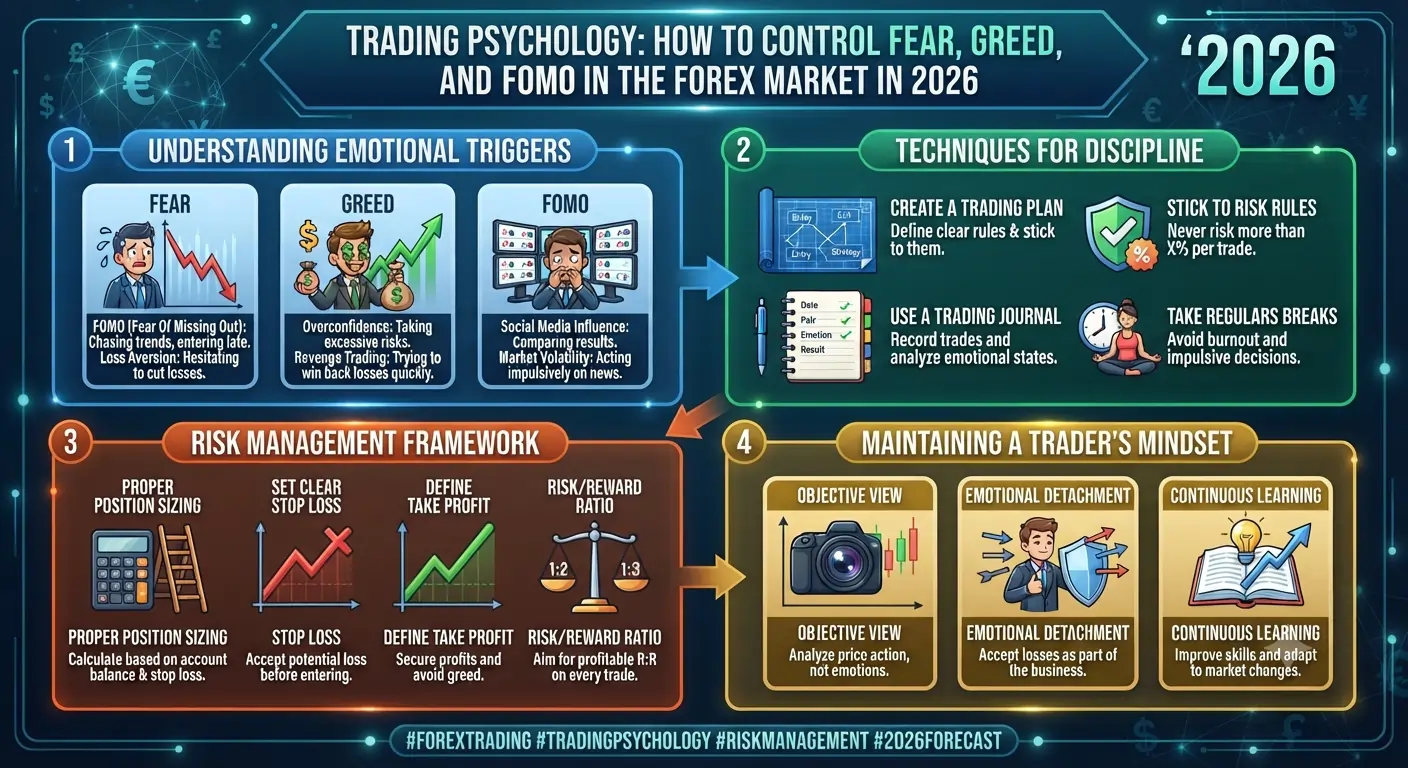
Trading psychology is the study and management of the emotional and cognitive processes that influence trading decisions. In forex trading, fear, greed, and FOMO (fear of missing out) are the three most destructive emotional forces, collectively responsible for the majority of avoidable losses in retail trading accounts. Controlling these emotions requires structured routines, pre-trade rules, post-trade journaling, and a shift from outcome-based thinking to process-based thinking. In 2026, with greater market access and higher volatility, psychological discipline is more important to trading success than it has ever been.
How Emotions Destroy Trading Accounts: The Data Behind It
The connection between emotional decision-making and trading losses is not anecdotal. It is documented extensively in behavioral finance research conducted since the 1970s, with more recent studies specifically examining retail forex traders in the modern environment.
Research published by the European Securities and Markets Authority (ESMA) in its 2024 and 2025 retail investor studies found that the most commonly cited behavioral errors among losing retail traders were: deviating from a predetermined trading plan due to emotions (cited by 67% of losing traders), increasing position size after a losing streak in an attempt to recover losses (cited by 58%), and exiting profitable trades too early out of fear of giving back gains (cited by 71%).
Nobel Prize-winning behavioral economists Daniel Kahneman and Amos Tversky established through their Prospect Theory research that humans experience the pain of a financial loss approximately 2.5 times more intensely than the pleasure of an equivalent financial gain. This cognitive asymmetry has profound implications for trading. It means that without deliberate countermeasures, a trader's emotional system is hardwired to make decisions that prioritize loss avoidance over profit optimization. The result is a systematic bias toward cutting winners short (to secure any gain before it disappears) and letting losers run (to avoid crystallizing the psychological pain of a confirmed loss).
These patterns directly destroy the risk-reward asymmetry that makes trading profitable. A system designed with 1:2 risk-reward trades becomes a 1:0.8 system in practice when fear causes early exits and hope causes late stops. The mathematical edge evaporates entirely.
Understanding FOMO in Forex and How to Eliminate It
- How Emotions Destroy Trading Accounts: The Data Behind It
- Understanding FOMO in Forex and How to Eliminate It
- The Fear of Losing: Why Traders Cut Winners Too Early
- Building a Pre-Trade Routine for Consistent Mental Discipline
- Journaling Your Trades: The Single Most Underrated Habit in Trading
- Key Takeaways on Trading Psychology for 2026 Forex Traders
FOMO, the fear of missing out, is arguably the most prevalent psychological trap in forex trading in 2026. The proliferation of social media trading communities, real-time profit screenshots shared on platforms such as X (formerly Twitter), Instagram, and Telegram, and the constant availability of live market data on mobile devices have amplified FOMO to levels that traders of previous generations never experienced.
FOMO in trading manifests in two primary ways. The first is entering a trade that has already moved significantly without a setup, simply because you see it moving and feel left out of the opportunity. A trader watching EUR/USD rally 80 pips without a position feels the pull to buy at the top of that move just to participate, ignoring the fact that the move has already occurred and the risk-reward on entry at that point is negative.
The second FOMO manifestation is abandoning a planned strategy for a faster-moving alternative. A trader with a systematic 4-hour swing trading approach sees a 1-minute scalp setup and impulsively takes it, operating outside their tested system because the immediate opportunity looks more exciting than waiting for their planned setup.
Both expressions of FOMO share a common structural feature: they are responses to what the market has already done rather than what the market is about to do. FOMO trades are entered based on past price movement, not based on forward-looking edge. And past movement is, by definition, the part of the opportunity that has already been missed.
The most effective countermeasure for FOMO is what professional traders call the opportunity cost reframe. When you feel the pull to chase a missed move, consciously articulate the following: the opportunity I am feeling FOMO about has already happened. The risk-reward on entering now is not the same as it was at the correct entry point. Another setup that meets my criteria will appear. Discipline preserved today is capital available to trade the next correct opportunity.
Creating a watchlist of 3 to 5 pairs that you actively monitor and a commitment to trade only from that list eliminates the endless scanning behavior that exposes traders to random FOMO impulses across the entire market.
The Fear of Losing: Why Traders Cut Winners Too Early
The fear of losing money on a winning trade (the fear of giving back unrealized gains) is the psychological force that prevents traders from achieving the risk-reward ratios their systems are designed for. This fear feels rational in the moment: you are sitting on a 60-pip profit and your take profit is at 120 pips. The trade pulls back 15 pips. The fear-driven response is to close immediately for 45 pips rather than endure the uncertainty of whether the full target will be reached.
The problem is that this behavior systematically destroys the mathematical edge of any positive risk-reward system. If you are using a system designed for 1:2 risk-reward but habitually exit at 0.8:1 due to fear, your system's expected value becomes negative across a sufficient sample of trades.
The solution is mechanical trade management through predefined rules applied before the trade is entered. Before clicking the buy or sell button, the take profit level must be placed on the chart. Once placed, it is not touched unless the original trade thesis is invalidated by new information such as a major unexpected economic release or a significant change in market structure on the higher timeframe. Personal anxiety about unrealized profits is not information. It is noise.
Recommended Articles
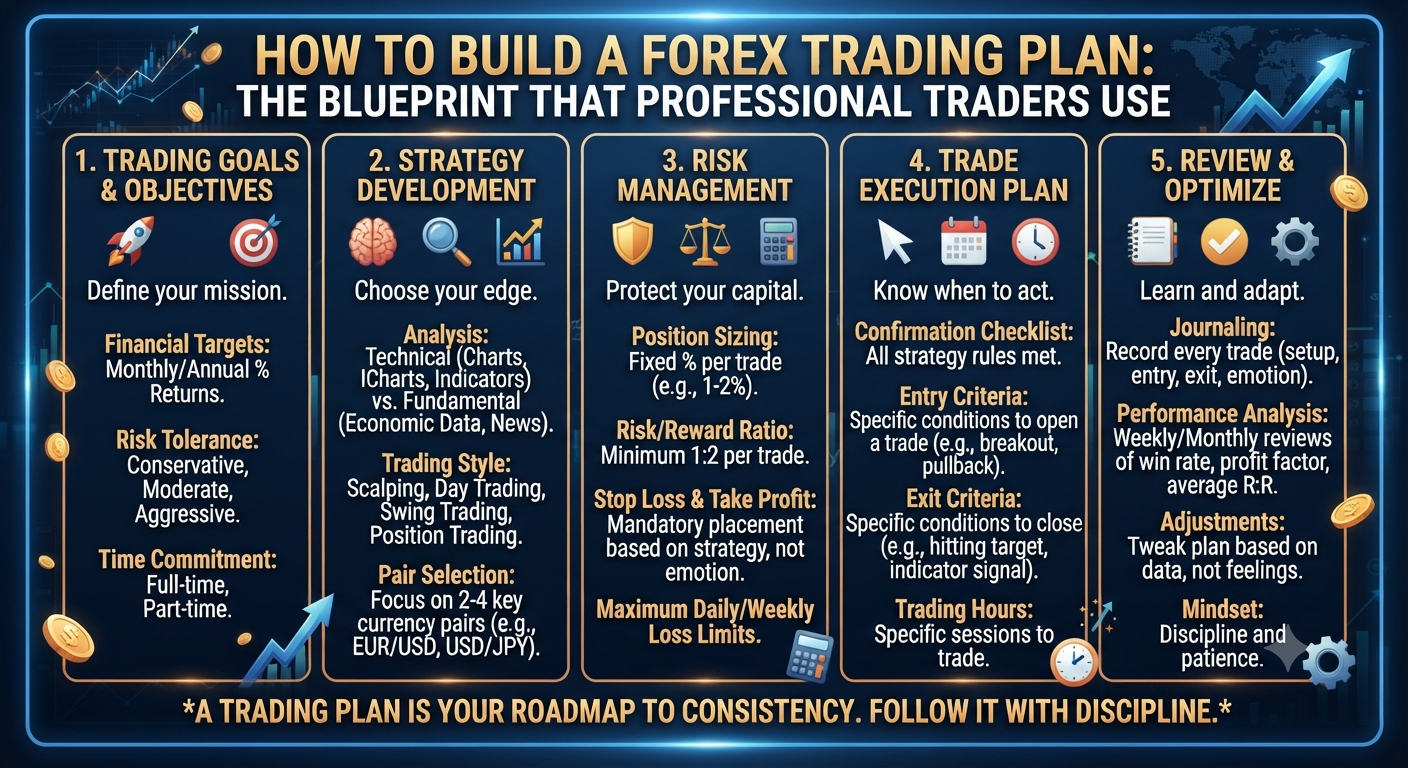 TRADING PSYCHOLOGY
Setting the take profit and walking away is a literal execution of this principle. Once a trade is live with stop loss and take profit in place, close the trading platform if necessary to prevent interference from real-time P&L watching. Many professional traders adopt this practice during the initial phase of learning not to interfere with their trades.
Building a Pre-Trade Routine for Consistent Mental Discipline
A pre-trade routine is a structured sequence of checks and mental preparation performed before any trade is entered. It serves two purposes: it ensures every trade meets the system's criteria before capital is committed, and it creates a deliberate pause between the identification of a setup and the act of entering, preventing impulsive action.
A complete pre-trade routine for a forex swing trader takes approximately five minutes and covers the following steps:
Check the higher timeframe context. Look at the daily chart and confirm the trend direction. Confirm that the trade you are about to take is aligned with the prevailing directional bias. If the daily chart is in a clear downtrend, do not take a 4-hour long trade based on a small support bounce without exceptional confluence.
Verify the setup meets all system criteria. Run through the specific entry rules of your trading system as a checklist. Are all conditions met? Is there EMA alignment? Has the RSI confirmation signal appeared? Is the candle closed? If any criterion is not met, the trade is not taken regardless of how strong the setup looks visually.
Calculate the exact position size. Before entering, determine the stop loss level, calculate the pip distance from entry to stop, and use the 1% risk rule formula to determine the exact lot size. This step prevents the emotionally driven impulse to trade larger after a winning streak or smaller after a losing one.
State the trade thesis aloud or in writing. Articulate in one sentence why you are taking this trade. For example: "I am buying EUR/USD at 1.0820 because price has pulled back to the 21-period EMA on the 4-hour chart in an established uptrend and produced a bullish engulfing candle with above-average volume." If you cannot state a clear thesis, you do not have a trade. You have a feeling.
Set the stop loss and take profit before clicking enter. These levels are determined by your analysis before the trade is entered. They are not adjusted after entry based on price movement or anxiety.
Journaling Your Trades: The Single Most Underrated Habit in Trading
The trading journal is the most consistently recommended tool by professional traders, trading coaches, and behavioral finance researchers for improving long-term performance. Yet studies suggest that fewer than 20% of retail forex traders in 2026 maintain any form of consistent trade log.
A complete trading journal entry includes the following data for every trade: date and time of entry, currency pair, trade direction, entry price, stop loss price, take profit price, position size, the specific setup criteria met, a screenshot of the chart at entry, the result (win, loss, or breakeven), the exit price, the profit or loss in pips and dollars, and critically, an emotional note capturing your mental state both before entry and during the trade.
The emotional notes component is what separates a meaningful journal from a simple trade log. Recording that you felt anxious about a trade and exited early, or that you felt overconfident and risked 2% instead of 1%, creates an auditable record of psychological patterns that are otherwise invisible to introspection.
Monthly journal reviews reveal patterns that no single trade analysis can uncover. You might discover that your win rate on trades taken on Monday is 65% but falls to 38% on Friday, suggesting that end-of-week fatigue or position-squaring dynamics are affecting your Friday trading. You might discover that your average risk-reward achieved is 1:1.4 rather than the 1:2 your system targets, identifying early exits as a systematic behavioral problem worth addressing through mechanical take-profit placement.
The journal is not just a record of what the market did to you. It is the primary diagnostic tool for understanding what you are doing to yourself. In 2026, digital journaling tools such as Edgewonk, TraderSync, and TraderVue offer automated analytics that visualize performance patterns across hundreds of trades, making the insight generation process significantly faster and more rigorous than manual spreadsheet analysis.
Key Takeaways on Trading Psychology for 2026 Forex Traders
Emotional control in forex trading is not a personality trait that traders either have or do not have. It is a skill developed through structured systems that remove discretionary decision-making during emotionally charged moments. The pre-trade routine converts impulsive entries into deliberate, criteria-based decisions. Mechanical stop loss and take profit placement converts anxious exit decisions into automatic processes. The trading journal converts isolated experiences into analyzable patterns. Together, these three practices address the three most destructive emotional forces in trading: fear, greed, and FOMO. Building them into your trading process from day one is not optional supplementary practice. It is the psychological infrastructure upon which everything else in your trading career will either stand or collapse.
Financial Disclaimer: This content is for educational purposes only and does not constitute financial advice. Trading forex involves substantial risk of financial loss. Seek independent professional advice before making trading decisions.